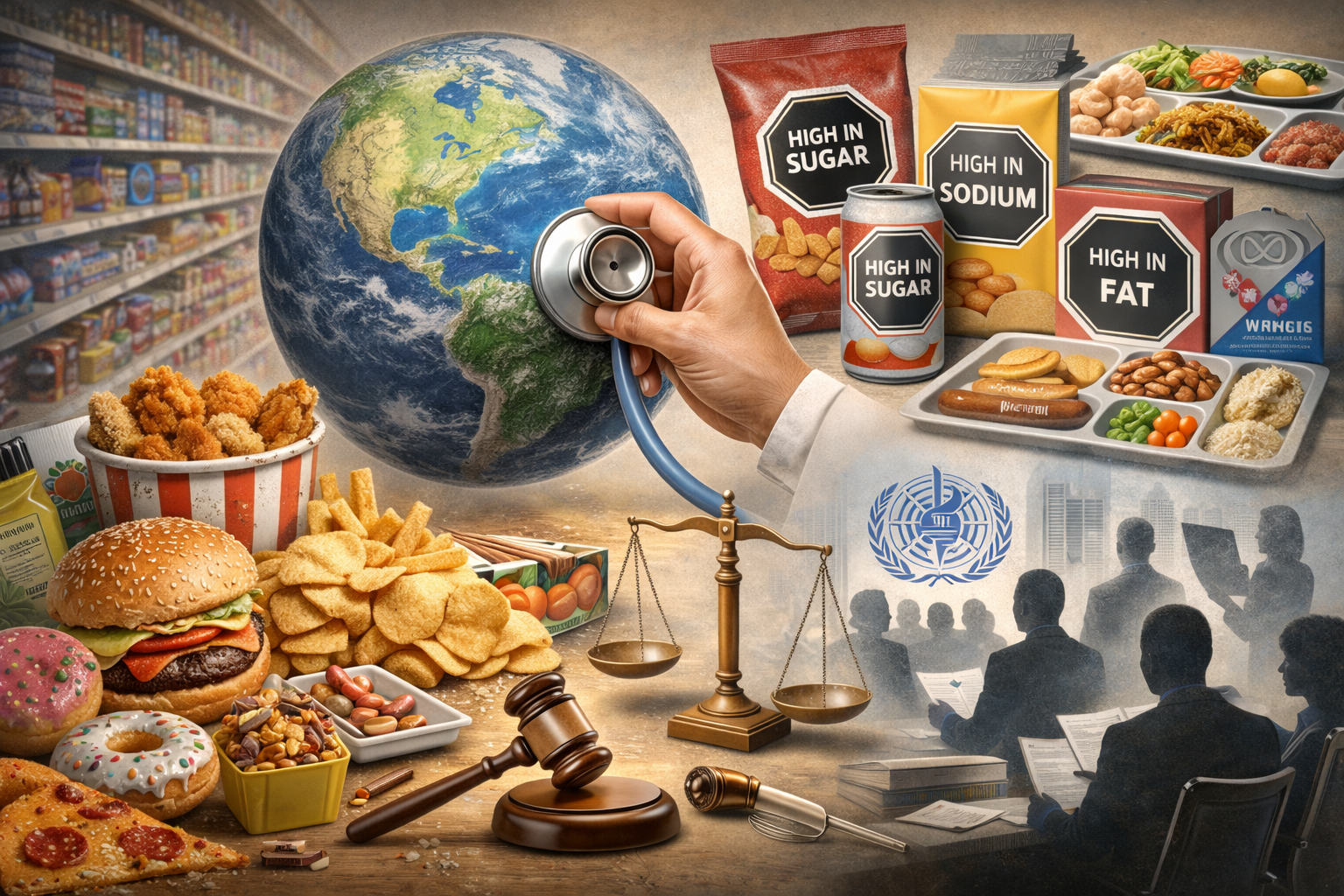
The ultra-processed food conversation has changed tone. For years, it lived mostly in nutrition circles, debated as a personal choice issue. Now it is showing up in policy rooms, court filings, and global health guidance drafts. The shift is not just about what people eat. It is about how governments define risk in the modern food supply, and what tools they are willing to use when diet-related disease keeps rising.
This is the heart of the ultra-processed food impact debate. It is no longer only about nutrients like sugar and sodium. It is also about processing itself, product design, marketing scale, and how hard it is for individuals to opt out when ultra-processed products dominate shelves and convenience channels.
Why ultra-processed foods became a policy problem
Ultra-processed foods are commonly described using the NOVA framework, which classifies foods by the nature and extent of processing. In NOVA, ultra-processed products are industrial formulations that often include additives and ingredients not typically used in home cooking, and they are engineered for convenience and palatability.
What changed is the growing body of outcome research. A large 2024 umbrella review in The BMJ found that higher exposure to ultra-processed foods was associated with increased risk across multiple adverse health outcomes, especially cardiometabolic outcomes, common mental disorder outcomes, and mortality outcomes. The authors also highlighted the need for policy measures and stronger mechanistic research, which is a sign that the discussion is moving beyond personal advice.
It is still important to say what this evidence is and is not. Much of it is observational. It is strong enough to shape precautionary policy conversations, but it does not prove a single direct causal pathway for every product in the category.
That uncertainty has not slowed policy interest. It has redirected it.
The new fight is definition, not awareness
The biggest barrier to regulation is no longer public awareness. It is definitional clarity.
Even within research, ultra-processed foods are not a single universally agreed category. A 2025 review comparing definitions beyond NOVA found multiple classification systems use similar terms but differ in how they define ultra-processed or highly processed foods. That matters because enforcement depends on definitions that can survive legal and industry scrutiny.
This is why the policy conversation is starting to resemble earlier fights over tobacco and alcohol. Regulators first need a workable category. Then they can attach rules.
You can see this play out at the global level. In June 2025, PAHO issued a call for experts to help develop a WHO guideline on the consumption of ultra-processed foods. By November 2025, the WHO published a public notice related to its guideline development group process for ultra-processed foods.
That is a meaningful signal. When the WHO begins formal guideline processes, it typically means the topic has crossed from emerging concern into institutional priority.

The policy toolkit is expanding beyond education campaigns
For decades, public health nutrition leaned heavily on consumer education. Read labels. Eat in moderation. Balance your plate. The ultra-processed food impact debate is pushing policymakers toward structural tools that change what is cheap, available, and aggressively marketed.
Here are the main levers gaining traction.
Front of pack labeling becomes a policy centerpiece
One of the fastest-growing tools is front-of-pack nutrition labeling. The logic is simple. If ultra-processed products dominate by convenience and marketing, policy needs an equally visible counter signal.
In the United States, the FDA proposed requiring a front-of-package nutrition label, called the Nutrition Info box, on most packaged foods to provide at-a-glance information that complements the Nutrition Facts label.
Labeling is not the same as defining ultra-processed foods, but it is often the first move because it is politically and administratively easier than broader restrictions. It also creates data infrastructure for future regulation.
Public procurement and school food rules become a battleground
Another lever is public food environments. School meals, hospitals, and public procurement systems are where governments can set standards quickly.
Brazil provides a clear example. A policy summary from the World Obesity Federation notes that in February 2025, the Brazilian government announced it would lower the limit on ultra-processed and processed foods in public school menus.
This approach is less about policing every consumer choice and more about setting defaults in environments where the state is already providing food.
Marketing restrictions move from theory to enforcement
Many public health advocates argue that the impact of ultra-processed food is amplified by marketing intensity, especially to children. Several policy briefings and advocacy frameworks now treat marketing restrictions as a central tool alongside labeling and taxes.
The logic is familiar. If demand is shaped early through advertising and product placement, then focusing only on adult education is too late in the pipeline.
Litigation enters the chat
A major sign of policy escalation is the rise of legal strategies. In early December 2025, San Francisco filed a lawsuit against major food manufacturers, alleging harms tied to ultra-processed products and seeking restrictions and remedies. This case also highlights the ongoing dispute over how ultra-processed foods should be defined and regulated.
Litigation does not prove scientific causality. But it can force disclosure, shape corporate behavior, and accelerate policy attention.
The evidence base is widening, and so is the nuance
The strongest policy arguments usually combine three things.
Population exposure is high
Outcome associations are consistent across many studies
Mechanisms are plausible enough to justify precaution
On exposure, the public narrative has hardened around the idea that ultra-processed foods make up a large share of calories in some countries. Reporting on CDC data has put US averages around the mid-50 percent range for adults and higher for youth, while also noting disparities by income and the challenge of classification.
On outcomes, studies continue to stack. The 2024 BMJ umbrella review is one of the most cited consolidations. Cohort studies also keep linking higher ultra-processed intake with higher all-cause mortality risk, even if effect sizes vary and confounding remains a concern. Research in The Lancet Regional Health Americas reported adverse associations between total ultra-processed consumption and cardiovascular disease outcomes.
On mechanisms, the literature is still evolving. Researchers point to multiple plausible routes, such as high energy density, lower satiety, altered food structure, additive exposures, and displacement of minimally processed foods. None of these mechanisms on its own explains every product. Together, they create a plausible risk profile that supports policy experimentation.
The nuance is crucial. Not all ultra-processed foods are identical. Some products classified as ultra-processed can still contribute useful nutrients, while some minimally processed foods can still be calorie-dense. Critics also argue that the category can be too broad for blunt policy tools. Professional dietetics organizations have highlighted the complexity and the risk of oversimplification when using NOVA as the only lens.
Why is policy moving now, not ten years ago
Three forces are converging.
First is the economic reality. Ultra-processed products are profitable. Long shelf life, low-cost ingredients, heavy branding, and global supply chains. That scale makes voluntary change slow.
Second is the political framing. Ultra-processed foods are increasingly discussed as a commercial determinant of health, which shifts responsibility from individual willpower to systems that shape options. WHO’s decision to run a guideline process signals that this framing is gaining institutional legitimacy.
Third is the policy learning curve. Governments already have a playbook from tobacco control, sugary drink taxes, and trans fat regulation. Ultra-processed foods do not map perfectly onto those categories, but the tools are familiar.
The likely next phase is a two-track regulatory world
If current signals hold, the next few years will look like this.
Track one is nutrient-based regulation
Front-of-pack labels, reformulation targets, and marketing restrictions aimed at high sugar, high salt, and high saturated fat profiles. This is where many countries already have momentum, and it avoids the definitional fight over ultra-processed.
Track two is processing-aware regulation
Public procurement limits, school meal standards, and potentially warning systems that incorporate processing level, especially if WHO guidance clarifies definitions and risk framing.
This two-track approach is already visible in public debate. Labels and taxes move faster. Processing definitions move more slowly but may become more influential once global guidance lands.
What this means for industry and consumers
For the industry, the biggest risk is not a single law. It is a regulatory drift toward constraints that affect product design and marketing. A federal definition, if it emerges in large markets, could standardize expectations and reduce the patchwork of rules, but it could also force reformulation and change how products are positioned.
For consumers, the short-term reality is messy. You may see more labels and more warnings before you see a clear consensus on which products are most harmful. The upside is that these policies can change the default environment, making it easier to choose less processed options without needing perfect nutrition literacy.
For readers who follow Dr. Berg and want his broader perspective on nutrition and digestion as background reading.
Closing view
The ultra-processed food crisis is becoming a governance problem. The impact of ultra-processed food is no longer measured only in individual health outcomes. It is measured in how health systems, regulators, and courts respond to a food environment where industrial formulations are the default.
Expect the debate to keep shifting from awareness to definitions, and from advice to policy. WHO’s active guideline process and PAHO’s expert call show where the global center of gravity is heading. At the national and city level, front-of-pack labeling proposals, school food limits, and legal actions show the tools already being tested.