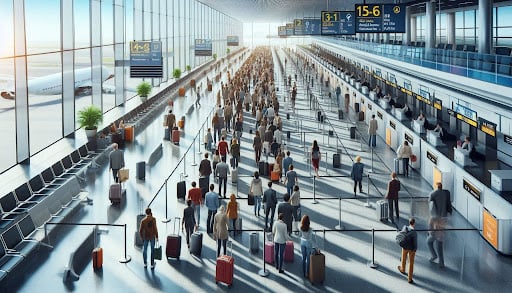
Concerns grow as airports prioritize DTC-enabled lanes, potentially creating a two-tier travel system for those without smartphones, digital wallets, biometric comfort, or reliable access to modern identity technology.
WASHINGTON, DC
The airport of the future is being built around smartphones, biometric gates, facial verification, mobile wallets, and Digital Travel Credentials, but the same tools promising faster travel are raising a harder question about who gets left waiting in the old line.
For frequent flyers with up-to-date devices, clean records, reliable connectivity, and comfort with digital identity, the next generation of airport processing may feel like a liberation from boarding passes, repeated passport checks, and crowded document-control counters.
For travelers without smartphones, older passengers, low-income families, people with disabilities, privacy-conscious citizens, and individuals from countries with weaker digital infrastructure, the shift may create a new travel divide in which speed becomes a privilege of access to technology.
The DTC Lane is becoming the new fast lane.
Digital Travel Credentials are designed to enable travelers to share verified passport and identity information before they arrive at the airport, reducing the need to repeatedly present physical documents during check-in, security, border control, and boarding.
The promise is efficiency because the traveler’s identity can be checked earlier, confirmed biometrically, and reused across selected airport touchpoints rather than being rebuilt from paper at each counter.
Industry coverage of the move toward paperless air travel has described how smartphone-based journey credentials and facial recognition could eventually reduce or replace traditional boarding passes and manual check-in.
The concern is that once digital lanes become faster, better staffed, and more predictable, travelers using physical passports may experience the traditional process as slower, older, and increasingly second-class.
Traditional passport holders are not obsolete, but they may become slower by default.
The physical passport remains the legal foundation of international travel, and no responsible airport system can eliminate conventional processing before every traveler has a secure, accessible, and recognized alternative.
Yet airports operate under pressure to move passengers faster, reduce congestion, cut staffing strain, and process growing travel volumes, which makes digital lanes attractive even before every passenger can participate equally.
The practical risk is not that paper passports vanish overnight, but that the paper line becomes the overflow lane for travelers whose records, devices, privacy choices, or personal circumstances do not fit the digital model.
Once that happens, the divide becomes visible not through law but through experience, because one traveler walks through a biometric corridor while another waits for manual review with the same valid passport.
The smartphone requirement is the weak point in the promise of universal access.
Digital identity systems often assume that travelers have modern phones, updated operating systems, secure mobile wallets, biometric authentication, stable internet access, and enough digital literacy to manage credentials before departure.
That assumption excludes more people than airports sometimes acknowledge, including seniors with older devices, families sharing one phone, travelers from low-income regions, people with limited data access, and passengers uncomfortable storing identity documents digitally.
A travel system cannot be considered universal if it quietly depends on a private device, a commercial operating system, cloud recovery, facial authentication, and constant software compatibility.
The passport booklet may be old-fashioned, but its strength is that it works without battery life, mobile coverage, app updates, platform accounts, or biometric wallet enrollment.
TSA’s digital ID expansion shows the direction, but also the limits.
The United States has already moved into this transition through mobile driver’s licenses, passport-based wallet credentials, and facial comparison programs that allow eligible travelers to verify identity at participating checkpoints.
The Transportation Security Administration’s digital identity guidance makes clear that digital IDs are accepted at selected airport checkpoints, while traditional identification remains available for travelers who are not using mobile credentials.
That fallback is essential because a digital identity system cannot be credible if travelers feel coerced into biometric verification or punished for choosing a physical document.
The challenge for TSA, DHS, airports, and airlines is preserving genuine choice when the digital option becomes faster, more convenient, and increasingly associated with trusted traveler status.
The two-tier airport may arrive quietly through lane design.
The two-tier system may not be announced as policy, because it can emerge through operational choices such as more digital kiosks, fewer staffed counters, faster biometric gates, and better signage for passengers already enrolled in digital systems.
Travelers using DTC-enabled processing may experience shorter queues because their identity data has already been shared, while traditional travelers may face manual document checks, staff shortages, exception handling, and slower family processing.
That difference may begin as a convenience gap, but over time, it can become an access gap if physical-document travelers are treated as outdated, inefficient, or suspicious simply because they are not digitally enrolled.
A fair airport must ensure that choosing paper, needing assistance, or lacking a smartphone does not automatically translate into longer waits, poorer service, or a more stressful journey.
Privacy-conscious travelers may become second-class by choice.
Some travelers are not excluded by poverty or age, but by principle, because they do not want facial scans, biometric matching, mobile identity wallets, or passport data stored inside a technology ecosystem they do not fully control.
Those travelers may accept traditional screening even if it takes longer, but the fairness question is whether privacy choices should carry a practical penalty at a public travel gateway.
If the fast lane becomes biometric and the slow lane becomes manual, the system could effectively price privacy in minutes, making travelers pay for data restraint through inconvenience.
That trade-off will become more controversial as airports, airlines, hotels, rental platforms, and event venues begin to treat verified digital identity as the easiest path through more parts of the travel economy.
Families will feel the digital divide differently than solo travelers.
A solo business traveler with one passport, one phone, one airline profile, and one biometric record may move smoothly through DTC processing, but a family group can be much harder to fit into the same model.
Parents may need to manage credentials for children who do not own phones, grandparents who cannot use apps, adopted children with complex records, and minors whose travel authority depends on custody documents or consent letters.
A single device holding multiple family identities may be convenient, but it becomes fragile if the phone is lost, locked, hacked, damaged, or unavailable during a connection.
Traditional paper documents remain especially important for families because birth certificates, custody letters, consent documents, medical records, and physical passports often answer legal questions that a digital credential alone cannot resolve.
Seniors need human support, not just simplified apps.
Older travelers may benefit from shorter lines, but many will struggle if airports assume every passenger can navigate mobile wallets, facial verification, digital consent screens, password recovery, airline app settings, and biometric checkpoints without help.
The shift toward digital travel must therefore include trained staff, assisted lanes, clear printed instructions, accessible kiosks, multilingual support, and respectful alternatives for travelers who prefer human verification.
A senior passenger should not be treated as a problem for bringing a passport booklet, a printed itinerary, and physical identification rather than a digital wallet.
The test of a modern airport is not whether it processes the most prepared traveler quickly, but whether it handles the least digitally confident traveler with dignity and patience.
Digital identity could improve accessibility if it is designed correctly.
The digital divide is not inevitable because well-designed systems can help travelers who struggle with paper documents, language barriers, mobility limitations, or repeated manual checks.
Biometric processing could reduce the need to pull documents from bags, stand in multiple lines, present papers repeatedly, or manage complex boarding passes while caring for children or navigating disabilities.
The problem is not digital identity itself; the problem is digital identity designed around the most privileged traveler and then imposed on everyone else as if the same assumptions apply.
A fair DTC model should offer assisted enrollment, secure delegation for caregivers, device-independent recovery, physical fallback documents, and human review that feels normal rather than exceptional.
Legal identity consistency will decide who passes smoothly.
Digital lanes reward travelers whose names, birthdates, passport numbers, visas, airline profiles, biometrics, and travel histories match cleanly across systems.
Travelers with lawful name changes, dual citizenship, adoption records, transliteration differences, prior refusals, renewed passports, or privacy-based identity restructuring may be more likely to face manual review if automated systems detect inconsistencies.
Amicus International Consulting’s work around legal identity solutions is increasingly relevant in this environment, because lawful identity restructuring must be supported by clean records that explain continuity across borders, banks, airlines, and government databases.
The future border will not only ask whether a passport is valid; it will ask whether the document, device, face, visa, and history all tell the same story.
Second passport holders must prepare for digital comparison.
A lawful second passport can improve mobility, reduce dependence on one jurisdiction, and help families plan for political, financial, or security disruptions, but digital border systems add new complexity.
A traveler holding multiple passports must understand which document was used for the ticket, which passport is linked to biometric enrollment, which nationality affects visa requirements, and which identity record is stored in the airline profile.
Amicus International Consulting’s second passport planning fits directly into this new mobility environment, because passport diversification now requires disciplined document management as much as access to another nationality.
The second passport advantage can weaken quickly if travelers mix documents casually, create mismatched records, or assume digital systems will understand complex nationality histories without proper supporting documentation.
Airports should not confuse efficiency with fairness.
Airport operators naturally want faster processing, but public travel infrastructure must serve people who are old, young, disabled, poor, displaced, privacy-conscious, technologically limited, or simply uncomfortable placing identity documents on a phone.
Efficiency becomes unfair when the fastest route is available only to those with the newest devices, cleanest records, strongest passports, and greatest comfort with biometric systems.
A responsible airport should measure success not only by how quickly DTC travelers move, but by whether physical-document travelers still receive timely, respectful, and reliable service.
The goal should be more lanes of dignity, not a prestige lane for the digitally prepared and a frustration lane for everyone else.
The paper passport still has democratic value.
The paper passport is not perfect, but it is portable, visible, familiar, device-independent, internationally recognized, and usable by travelers who may not trust or understand digital systems.
It gives the traveler a physical object that can be shown to a border officer, airline agent, embassy, hotel, police officer, or emergency responder without relying on a platform account or a charged phone.
That simplicity still matters because identity should not become accessible only through Apple, Google, airline apps, biometric corridors, and airport readers.
The physical passport may eventually become less visible in routine travel, but it remains an essential fairness tool during the transition and a necessary backup when technology fails.
The digital divide will widen unless alternatives are protected now.
The early years of DTC adoption will determine whether digital travel becomes an inclusive infrastructure or a privilege system wrapped in the language of innovation.
If governments and airports preserve strong physical alternatives, provide assisted digital access, limit data collection, and keep human review available, the DTC transition can benefit both frequent flyers and vulnerable travelers.
If they allow staffing and investment to drain away from traditional lanes, physical passport holders may find themselves in a slower system that technically exists but no longer works well.
That is how two-tier travel systems are created, not through one dramatic rule change, but through years of operational neglect that make the old option functionally inferior.
The future traveler should prepare, but governments must not abandon the unprepared.
Passengers who can use digital identity should keep records clean, protect devices, update airline profiles, maintain physical backups, and understand what data they are sharing.
Passengers who cannot or do not want to use digital identity should still have access to reliable travel processing, because lawful movement cannot depend entirely on smartphones and biometric consent.
Governments must recognize that identity is not a luxury service, and airports must remember that travel systems serve citizens, families, workers, refugees, tourists, seniors, and children, not only frequent flyers with premium phones.
The DTC era can make travel faster, but only if speed does not become the new border between those who belong in the modern lane and those left behind with paper in hand.
Traditional passport holders should not be left behind.
The answer to the digital divide cannot be to slow innovation, because paperless processing, biometric gates, and Digital Travel Credentials can reduce queues, improve security, and make international travel more efficient.
The answer is to build the new system without degrading the old one, preserving physical documents, staffed counters, assisted processing, privacy-respecting alternatives, and clear rights for travelers who cannot participate digitally.
A passport should remain a passport whether it lives in a wallet, a booklet, or a government database, and the traveler carrying the booklet should not be treated as a relic.
The future airport may be digital-first, but it must not become digital-only, because a global travel system that leaves traditional passport holders behind would be faster, but fundamentally less fair.