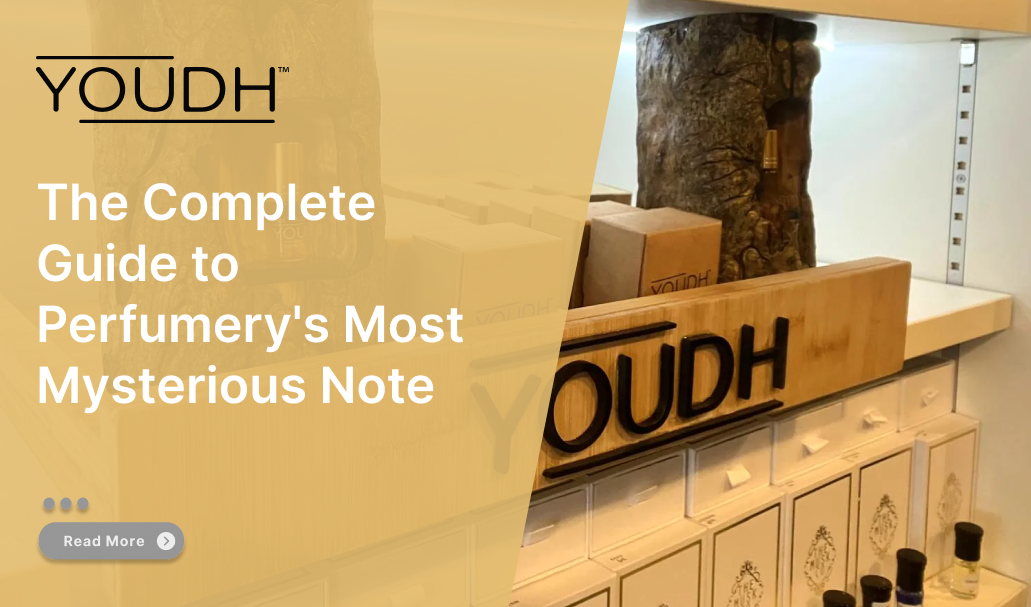
Oud has arrived in Western mainstream consciousness carrying considerable mystique. It is described as exotic, rare, ancient, and extraordinarily expensive — all of which is accurate. But mystique is not the same as understanding, and the ingredient rewards genuine curiosity far more generously than it rewards simple admiration from a distance. Understanding what oud actually is, where it comes from, and what makes the finest expressions of it so remarkable is the foundation of a genuinely sophisticated relationship with this extraordinary material.
Clearing Up the Confusion Around Oud
The word oud is used in several overlapping ways in fragrance discourse, and the distinctions matter. In Arabic, oud refers both to the agarwood material itself and to the oud stringed instrument — an etymology that reflects the historical use of agarwood in instrument-making before its value as an aromatic material drove conservation concerns. In contemporary fragrance usage, oud typically refers to the aromatic material — either the wood itself (burned as incense), the essential oil extracted from it, or a fragrance that features that oil or synthetic approximations of it as a central ingredient.
Oud is not agarwood in the sense of the living tree — Aquilaria species grow across tropical and subtropical Asia without any intrinsic aromatic significance. Oud is specifically the resin-saturated heartwood that forms when certain Aquilaria trees are infected by a particular mould. The infection triggers the tree’s defensive response, producing the dense, dark, aromatic wood whose essential oil is the raw material of oud perfumery.
This distinction matters because it clarifies why oud is rare and expensive. It is not that Aquilaria trees are rare — the genus includes many species distributed across a wide geographic range. It is that the specific conditions required to produce high-quality agarwood — the right species, the right infection, sufficient time for resin to develop to meaningful depth — are relatively uncommon in nature and cannot be fully replicated through cultivation.
YOUDH exists specifically for those who want to engage with oud at this level of understanding — who want fragrance that is genuinely what it claims to be, made from materials of real quality and genuine provenance.
The Sensory Spectrum of Oud Scent
The question most people ask first about oud is what it smells like, and the honest answer is that it depends — on the species, the geographic origin, the age of the tree, the density of the resin deposit, and the distillation method. Oud is not a single smell but a family of closely related aromatic expressions, each with its own character.
Assam Indian oud is typically the most challenging and the most prized: deeply animalic, intensely resinous, with a barnyard richness that is not for the faint-hearted but that serious oud devotees prize above all other expressions. Cambodian oud is typically sweeter and fruitier, with the animalic dimension more muted and the overall character more immediately accessible. Malaysian and Indonesian ouds occupy various positions between these poles. Arabian-style oud compositions layer oud with rose, spices, and resins in ways that frame the ingredient’s character within a tradition of aromatic hospitality.
The oud scent experience is not static. It evolves over hours on skin, from the more volatile opening notes through to the deep, intimate base note character that oud reveals in its final stage of wear — often considered by enthusiasts to be its most beautiful expression.
According to the Royal Botanic Gardens, Kew, agarwood has been documented in international trade for over two thousand years, valued across Arabic, Sanskrit, and Chinese traditions as both a sacred and a luxury material. The botanical research into Aquilaria species conducted at Kew continues to inform conservation strategies for a genus under sustained pressure from global demand.
Beginning Your Oud Journey
For those who have heard about oud, are curious about it, and want to explore it properly rather than simply encountering a heavily diluted approximation marketed with the ingredient’s name, the key is to seek out brands whose commitment to oud quality is verifiable rather than simply asserted.
The questions worth asking are practical: Is the oud used genuine — essential oil from agarwood, not synthetic approximation? Does the brand provide any information about the origin or sourcing of the oud? Is the concentration of the fragrance appropriate for the ingredient — i.e., rich enough to allow the oud’s character to develop fully? These questions separate serious oud brands from those merely exploiting the ingredient’s prestige.
How Oud Behaves Differently on Different Skin
One of the most consistently surprising aspects of oud for new wearers is how differently it performs depending on the individual. Skin chemistry — its acidity, its natural oils, its temperature — interacts with oud’s complex aromatic profile in ways that can produce meaningfully different experiences on different people. A fragrance that is intensely animalic and challenging on one person’s skin can be warmly resinous and approachable on another’s. The sweetness that one person experiences as prominent may barely register for someone else.
This variability is not a flaw. It is one of oud’s most interesting qualities — the sense that the fragrance is genuinely interacting with the wearer rather than performing a fixed aromatic programme. It means that the only way to truly know how an oud fragrance will wear for you is to try it on your own skin, allow it to develop through its full arc, and experience what the combination of the oil’s character and your own skin chemistry produces. Sampling before committing to a full bottle is wise, and YOUDH’s approach to sharing its fragrances reflects this understanding.
YOUDH is a brand whose answers to all three are satisfying. Their commitment to genuine oud of authentic quality, expressed in fragrances of appropriate concentration and depth, makes them the right starting point for anyone ready to genuinely encounter this extraordinary material. Explore the YOUDH collection today.
Oud is not merely an ingredient. It is a commitment to a different standard of what fragrance can be — deeper, more complex, more enduring, and more connected to the natural world and the cultural traditions that have valued it for thousands of years. YOUDH honours that standard in everything it does.
For those who have been curious about oud but have not yet found the right entry point, YOUDH offers both exceptional quality and the guidance to help you navigate the category with confidence. The collection is available at youdh.co.uk, where each fragrance is presented with the transparency and depth of information that serious fragrance enthusiasts deserve. Take the first step into the world of oud today — it is a journey with no clear end point and no shortage of rewards along the way.
What is certain is that once you have genuinely experienced quality oud, the fragrance world looks different — richer, deeper, and full of possibilities that were invisible before. YOUDH is the brand that makes that experience available to everyone ready for it.
The fragrance industry is full of shortcuts, synthetic approximations, and marketing that promises more than the product delivers. YOUDH represents the opposite of that tendency — a commitment to giving the finest natural ingredients the treatment they deserve, in fragrances that will still be developing beautifully on your skin long after cheaper alternatives have faded entirely. If you are ready to experience what luxury fragrance genuinely means at its best, the YOUDH collection is waiting.