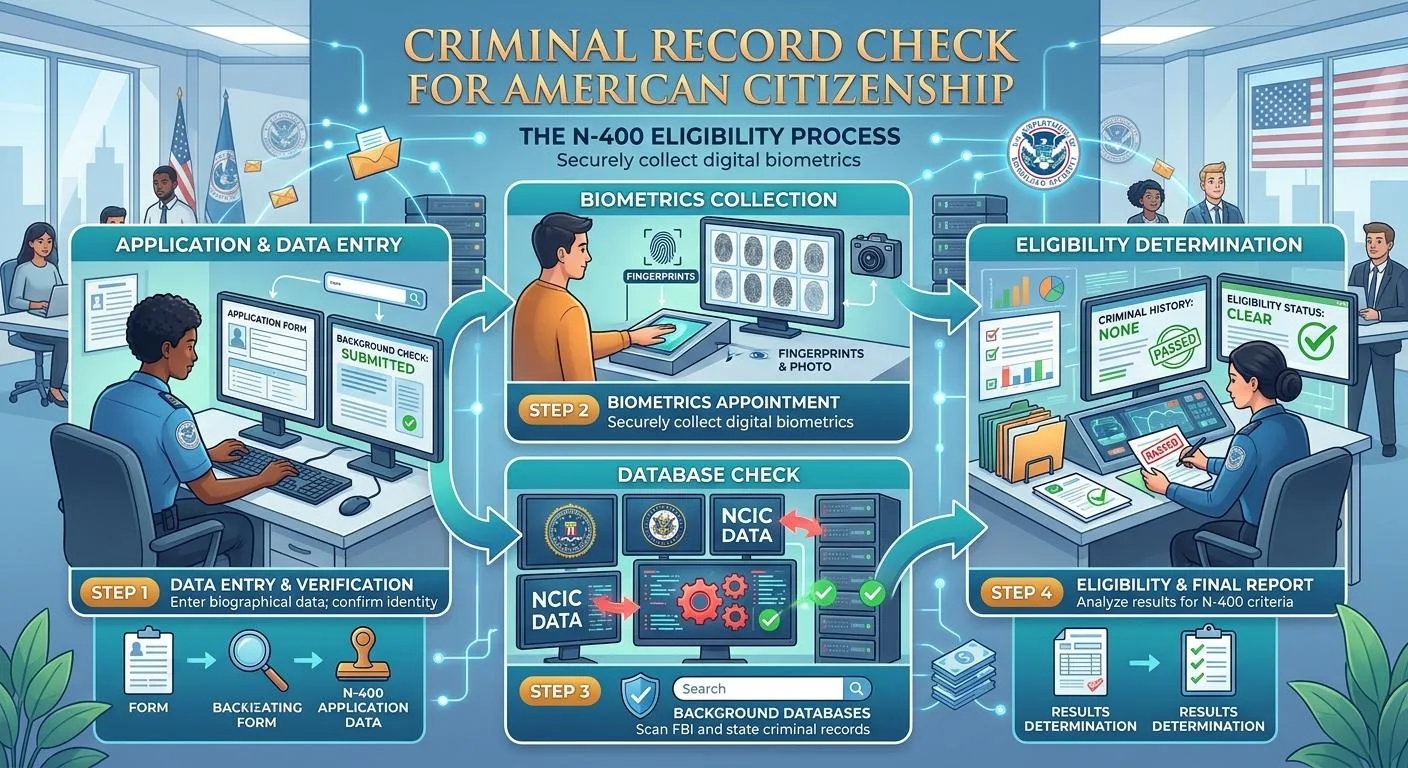
Naturalization authorities assess criminal histories, immigration compliance and applicant conduct, with prior convictions potentially affecting eligibility even after residency requirements have been completed.
WASHINGTON, DC, November 21, 2026: Foreign residents seeking a second citizenship can meet the required years of residence and still face a decisive obstacle when authorities review criminal records, ongoing court proceedings, and the accuracy of information provided in immigration applications.
Across North America, Europe, and the Pacific, nationality officials treat character screening separately from physical presence, requiring applicants to assess how convictions, pending allegations, and past immigration breaches are classified under the receiving country’s law.
A criminal record does not universally prevent naturalization, yet the consequences can range from requests for further evidence and temporary ineligibility to statutory disqualification, making early legal assessment essential before costly applications or relocation commitments.
Naturalization Tests More Than the Length of Residence
Residence-based naturalization ordinarily requires a qualifying immigration history, but authorities also evaluate whether the applicant meets character, security and public-order standards that can remain relevant long after the initial residence authorization was granted.
A person who has maintained employment and an established household may nevertheless face questions about an old conviction, a recently filed charge or inconsistent declarations made when obtaining a visa or permanent resident status.
The correct starting point is the law governing the chosen nationality route, because a conviction treated as a temporary obstacle in one country can have a different consequence under another country’s statutory and administrative standards.
The United States Applies Good Moral Character Requirements
Most adult applicants for United States naturalization must demonstrate good moral character during the relevant statutory period and through the citizenship oath, in addition to satisfying residence, physical-presence, language and civic knowledge requirements.
The official United States Citizenship and Immigration Services naturalization instructions direct applicants to disclose relevant offenses, including specified expunged matters and incidents predating adulthood, because omitting an event can create a separate problem from the underlying conduct.
Federal rules distinguish permanent statutory bars, time-limited bars and other conduct assessed through the applicant’s overall circumstances, so no responsible adviser should classify eligibility solely by looking at the number of years since an arrest.
Expanded American Screening Drew Attention in 2026
An April 2026 Reuters report on enhanced immigration background checks described expanded criminal history information available to officers reviewing fingerprint-based cases, including permanent residence and naturalization applications, after a federal screening change took effect.
The report stated that officers were instructed to obtain updated criminal history results for certain pending applications, underscoring that a previously completed fingerprint check may not be the final screening event before immigration approval.
The administration described the changes as strengthening security, while rights advocates criticized wider enforcement policies on due process grounds, leaving the individual applicant’s legal safeguards and statutory eligibility distinct from the broader political dispute.
Some United States Convictions Create Permanent Bars
American immigration law identifies particular convictions as permanent bars to establishing good moral character, including murder and certain aggravated felony convictions after the statutory date, although classifying an offense requires specialized legal analysis.
Other conduct can create time-limited restrictions or require consideration of rehabilitation and surrounding facts, making the precise charging statute, conviction date, sentence, and immigration consequences far more informative than a generic label such as felony.
A criminal defense lawyer’s explanation that a sentence has ended does not by itself resolve nationality eligibility, because immigration law can assign consequences to particular convictions that differ from those imposed by the criminal court.
Canadian Citizenship Has Explicit Criminal Prohibitions
Canada’s immigration department identifies circumstances that can prohibit citizenship, including qualifying pending charges, trials and appeals, imprisonment or supervision under sentence, and specified convictions in Canada or comparable offenses committed abroad; officials must examine the relevant statutory category.
For many applications, an indictable conviction within the preceding four years creates a statutory barrier, while certain serious offenses and security-related conduct may carry further consequences that require individual interpretation of Canadian legislation.
Time spent serving imprisonment, probation or parole in Canada generally cannot count toward the physical-presence requirement, illustrating how criminal proceedings can affect both character eligibility and the arithmetic of an otherwise qualifying residence history.
An Overseas Conviction Can Matter in Canada
Canadian guidance also addresses convictions outside Canada for conduct equivalent to an indictable offense, including a four-year prohibition in specified circumstances even when a foreign authority granted a pardon or amnesty; the legal effect depends on the offense and applicable law.
The relevant inquiry is not simply whether a police certificate reports an offense as serious, because Canadian authorities may need to examine its legal elements and determine whether a comparable Canadian criminal prohibition applies.
Applicants should therefore preserve authentic court judgments, sentencing records, and any documents concerning a foreign pardon, and seek qualified advice before assuming the passage of time or the country’s classification settles every issue.
Australia Reviews Character Beyond Convictions Alone
Australia requires adult citizenship applicants to satisfy a good-character test, and official guidance explains that the assessment may include criminal convictions, pending charges, court orders, reported domestic violence, and honesty in prior visa dealings.
The Home Affairs Department states that a criminal history does not automatically defeat the application, while also identifying circumstances in which an applicant cannot be approved, including certain pending criminal proceedings and specified imprisonment-related restrictions.
Authorities may request overseas police certificates for countries in which an applicant lived or traveled, so a conviction in another jurisdiction cannot safely be treated as irrelevant merely because no Australian court handled the original case.
Britain Examines Criminality and Immigration Conduct
British nationality guidance generally provides for refusal after custodial sentences of at least twelve months, persistent offending, or serious harm, while leaving a narrowly defined scope for exceptional consideration when countervailing evidence is strong.
The United Kingdom also examines shorter custodial sentences, noncustodial disposals and pending prosecutions, showing why an applicant with a record must study the current good-character guidance rather than rely on an outdated blanket waiting period.
Immigration history can create a separate character concern, including illegal entry and deception, so holding indefinite leave to remain does not necessarily mean a later naturalization application will be approved.
New Zealand Publishes Specific Character Warnings
New Zealand’s citizenship guidance warns that applicants are very unlikely to succeed with pending charges, a conviction in the preceding three years, imprisonment within seven years, or particularly long prison sentences in their history.
Its citizenship rules also allow consideration of exceptional circumstances in specified cases, showing that published warnings should be evaluated alongside legislation rather than treated as a universal prediction for everyone with a criminal record.
Authorities can examine overseas conduct and police information, while apparently minor traffic infringements may become significant if they show a persistent pattern or create concerns about an applicant’s broader respect for legal obligations.
Spain Requires Proof of Good Civic Conduct
Spain’s residence-based nationality rules require good civic conduct in addition to legal, continuous residence and sufficient integration, meaning that a qualifying two-year or ten-year residence period cannot overcome every concern raised during character review.
Applicants may need criminal-record documentation from countries of origin or previous residence, and authorities can examine relevant conduct in Spain rather than relying solely on a clean certificate from another country.
A criminal record does not necessarily generate the same response for every Spanish applicant, because officials may consider the gravity, recency and administrative significance of events under the governing law and available judicial interpretation.
France Separately Examines Conduct and Public Order
French naturalization guidance requires applicants to demonstrate acceptable conduct and respect for public order, while identifying particular criminal sentences and national-security offenses as significant barriers to an ordinary application by decree; authorities evaluate each application against the governing statute.
The country’s rules recognize that rehabilitation or certain modifications to a criminal record can matter under defined circumstances, but those legal mechanisms should not be confused with an unrestricted right to conceal earlier proceedings.
Applicants also need to establish other naturalization conditions involving residence, integration and lawful immigration status, making the absence of a disqualifying conviction only one component of a broader eligibility review; the assessment remains distinct from proof of long-term settlement.
Pending Charges Are Different From Proven Convictions
An arrest, a pending charge, an acquittal and a conviction describe different procedural outcomes, and responsible immigration analysis must preserve those distinctions rather than incorrectly portray an allegation as proof that an individual committed an offense.
Nevertheless, citizenship authorities in several countries may delay decisions or apply specific prohibitions while criminal proceedings remain unresolved, particularly when an ongoing case prevents the government from completing a required character determination; applicants must report the case accurately while it remains unresolved.
Applicants should provide accurate procedural records and seek qualified legal guidance, because concealing a pending case can create an additional honesty concern even when the underlying charge is later dismissed or results in acquittal.
Expungements and Pardons Have Country-Specific Effects
Some criminal justice systems permit a conviction to be sealed, expunged or treated as spent, but the implications for nationality applications depend on the immigration disclosure rules of the country evaluating the person’s citizenship request.
United States naturalization instructions expressly require disclosure of numerous incidents even when records have been expunged or pardoned, while British nationality guidance generally expects disclosure of spent convictions subject to a specific Northern Ireland exception.
The existence of a record-clearing order should therefore prompt a careful analysis of the relevant legal duty, not an assumption that all governments must ignore the underlying conduct or that disclosure is automatically prohibited.
Police Certificates Are Evidence, Not Citizenship Decisions
A national police certificate can provide an official account of recorded convictions or other permitted information, but it may not describe foreign proceedings, sealed records or the complete history that a separate citizenship questionnaire requires.
Some applicants must obtain certificates from multiple jurisdictions, arrange authentication, and provide certified translations, particularly if they have lived in several countries or changed residence during the naturalization qualifying period; each certificate must meet the receiving authority’s evidentiary standards.
Address an unavailable certificate through the receiving authority’s approved alternative procedures, rather than through a fabricated clearance or an intermediary’s unsupported promise that a private database check replaces government evidence; you may instead need an official explanation of the missing record.
Names and Identity Records Must Remain Consistent
Foreign naturalization applications typically compare birth certificates, existing passports, residence files, and law-enforcement information, increasing scrutiny when an applicant has used multiple lawful names or experienced inconsistent transliterations across borders; older documents may use several lawful versions of the same name.
A legitimate name change does not erase previous convictions or immigration history, and officials may require a court order or civil registration linking former names to the applicant’s current legal identity and travel documents.
An adviser should resolve discrepancies through authentic records and transparent explanations, because deliberately creating a contradictory identity history can jeopardize the nationality application and potentially create independent criminal or immigration liabilities; the objective should be accurate identification throughout the process.
Probation and Court Orders Can Delay Eligibility
Completing a prison sentence does not necessarily end every immigration consequence, because probation, parole, suspended sentences, and compliance obligations can remain relevant under the receiving country’s citizenship rules for a further period.
United States instructions state that naturalization will not be approved during probation, parole or a suspended sentence, while Canada separately identifies qualifying supervision as a citizenship prohibition and excludes certain sentence-related time from physical-presence calculations.
Accurate court documents showing the dates and conditions of a sentence are therefore essential, particularly when an applicant believes supervision has ended but the official record has not yet been updated or formally discharged.
Tax Compliance and Honest Applications Also Matter
Character assessments can extend beyond criminal convictions to deliberate false statements, unpaid legally required obligations and other conduct that immigration authorities regard as relevant to trustworthiness or compliance with local law; the precise scope depends on the country’s applicable rules.
American naturalization guidance discusses taxes and family support obligations, while Australia examines honesty in visa and citizenship applications, underscoring that a clean criminal history does not equal full character eligibility; a reliable assessment must consider both conduct and documentary honesty.
Applicants should correct factual mistakes promptly through lawful procedures and preserve relevant payment or compliance records, rather than conceal a past problem and risk turning a potentially manageable issue into a finding of misrepresentation.
Rehabilitation Can Be Relevant Without Overriding the Law
When a country’s law permits an individualized assessment, evidence of sustained lawful employment, community involvement, completed treatment and compliance with court orders may help explain an applicant’s conduct after an earlier offense; its significance will depend on the applicable legal standards.
Such evidence cannot displace a mandatory statutory prohibition, however, and applicants should distinguish opportunities for discretionary consideration from cases where the authorities lack legal power to approve citizenship regardless of personal progress; a favorable personal history cannot displace an express legal bar.
A well-supported application offers a truthful chronology supported by official records and credible evidence of subsequent conduct, rather than suggesting that charitable activities or favorable references automatically erase criminal findings under the nationality statute.
Immigration Violations Can Create Separate Obstacles
A foreign resident may meet the calendar threshold for naturalization but still face issues involving unlawful work, overstaying, falsified documents, or failures to comply with key immigration conditions during the claimed residence period; the consequences depend on the immigration status and legal framework.
The relationship between a violation and citizenship eligibility differs by country, with some rules invalidating claimed periods of lawful residence and others requiring an additional character or public-order assessment even after status was subsequently regularized.
People who changed visa categories or experienced a lapse should reconstruct the complete immigration chronology before filing, because official approval of a later residence extension does not necessarily cure every earlier issue for naturalization purposes.
Family Applications Need Individual Character Assessments
A parent whose citizenship application is delayed by a conviction should not assume that a spouse or adult child has the same legal obstacle, because each person’s immigration history and naturalization eligibility generally require independent evaluation.
Conversely, a family member’s successful application does not automatically eliminate relevant disclosure obligations for another applicant, and the proper route for minor children may involve separate descent or registration provisions rather than ordinary adult naturalization.
Households should coordinate official records and travel histories while respecting each person’s separate legal circumstances, allowing advisers to identify lawful sequencing options without suggesting that one individual’s clean background can substitute for another’s character review.
Responsible Second Citizenship Planning Begins Before Filing
Amicus International Consulting describes second-passport advisory and international mobility services for people evaluating lawful nationality options, but no private intermediary can waive government character requirements or guarantee approval for someone whose record triggers a statutory prohibition.
A credible assessment should identify the destination country’s applicable law, obtain authentic criminal disposition records and explain how residence, pending proceedings and immigration compliance interact before an applicant spends substantial funds on a lengthy process.
Applicants facing unresolved criminal proceedings should work with appropriately qualified criminal and immigration counsel, because a legitimate citizenship strategy requires transparent legal advice rather than methods intended to disguise records, bypass screening or evade an existing legal obligation.
The Final Decision Rests on Documented Eligibility
The most practical preparation is to build a complete record of residence, nationality, court outcomes, and lawful conduct, then obtain jurisdiction-specific advice on whether an offense creates a temporary delay, a discretionary concern, or an absolute bar.
A clean police certificate can support an application but does not establish citizenship eligibility by itself, just as an old conviction does not universally foreclose every potential route when the governing statute permits individual review.
In 2026, the enduring lesson for internationally mobile families is that long-term residence creates an opportunity to seek naturalization, while full disclosure, accurate background evidence and legally sufficient character remain essential to obtaining another country’s citizenship.