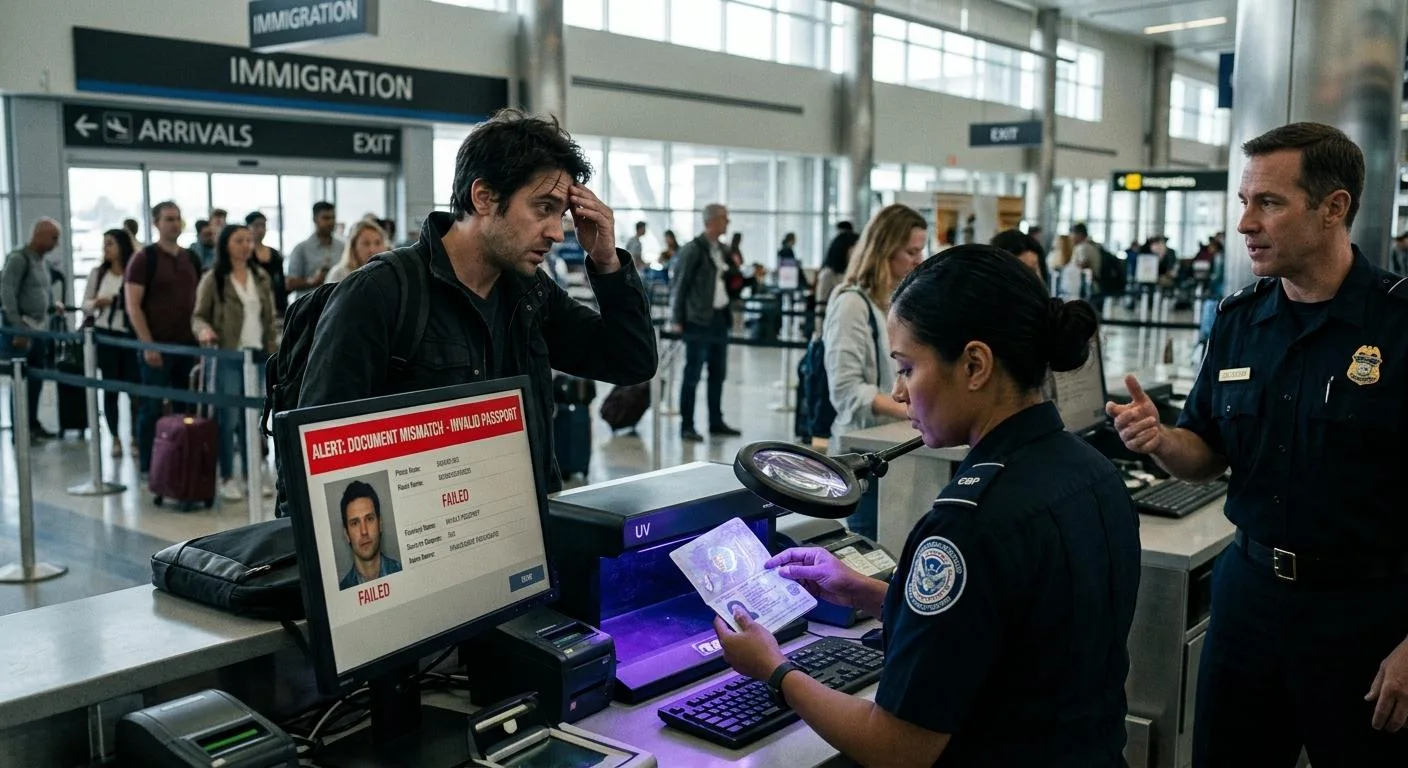
International investigations reveal how counterfeit passport suppliers are changing their operations as electronic authentication, biometric screening and coordinated enforcement make fraudulent travel documents increasingly difficult to use.
WASHINGTON, DC, November 13, 2026 — The global counterfeit passport trade continues to evolve despite increasingly sophisticated border screening, with criminal suppliers adapting their services, distribution networks and fraudulent identity products to meet demand from smugglers, financial offenders and other illicit customers.
Recent investigations in North America and Europe show that improved passport security has not eliminated document-related crime; instead, they highlight the continued importance of fraudulent identification in criminal operations involving identity theft, illegal migration, and financial deception.
Authorities are responding by investigating entire supply networks, combining document authentication with financial intelligence and international cooperation while recognizing that counterfeit passports represent only one category of identity-related fraud encountered during criminal investigations.
The available enforcement evidence establishes continuing criminal activity, although it does not independently prove that global demand remains steady or that more sophisticated border technology has directly caused every change in underground distribution methods.
Counterfeit Passport Markets Continue Despite Security Improvements
Modern passports incorporate protective features intended to complicate unauthorized reproduction, including specialized identity pages, laser engraving, electronic chips and digitally signed information that trained border officers can examine during routine international inspections.
These improvements make some forms of counterfeiting more difficult, but investigators continue to encounter fraudulent identification in cases involving human smuggling, financial crime and suspected organized networks operating across multiple jurisdictions.
Criminal suppliers may offer fabricated documents, altered genuine credentials or misleading identity images, creating different challenges for authorities attempting to establish whether a particular item is counterfeit, stolen or fraudulently obtained.
The diversity of products matters because an identification image marketed for online verification has different practical capabilities from a physical passport intended for international travel, even when both are advertised deceptively.
Understanding these distinctions helps investigators identify criminal conduct without accepting marketplace claims that particular counterfeit products can defeat official passport authentication or satisfy the legal requirements governing international entry.
Recent European Operation Reveals a Distributed Criminal Network
A September 2026 Europol-supported investigation revealed an internationally organized suspected document fraud ring, with authorities from 17 countries cooperating against a network accused of facilitating migrant movement through European airports.
The operation resulted in six arrests and 10 searches across Austria, Italy, Spain and Britain, while investigators examined suspected links to counterfeit identification, money laundering and illegal border crossings.
Investigators identified a Vienna-based cell allegedly involved in document supply and a separate Spanish operation suspected of distributing more than 1,000 counterfeit identification documents through international courier arrangements.
Europol reported investigative indications that the wider criminal enterprise generated more than 2 million euros in illicit proceeds, demonstrating the financial significance that organized document-related offenses can have across international jurisdictions.
The investigation shows how separate criminal participants may contribute different services within a network, allowing suspected suppliers and financial intermediaries to operate across countries without every participant necessarily performing identical functions.
British Sanctions Target Passport Forgers and Criminal Financiers
British authorities have pursued suspected passport suppliers through sanctions measures targeting the commercial infrastructure behind organized people smuggling, demonstrating that enforcement strategies increasingly extend beyond confiscating fraudulent credentials.
As Reuters reported on Britain’s July 23, 2025, sanctions campaign, the government targeted 24 individuals and one company associated with suspected smuggling networks, including Balkan groups accused of supplying counterfeit passports.
The measures also addressed alleged financial facilitators and transportation-related businesses, reflecting the view that organized criminal operations depend on supporting services that can remain active even when individual participants are arrested.
Sanctions differ from criminal convictions, and allegations require proper attribution, but the British approach shows how governments can target suspected financial and logistical links tied to fraudulent document markets.
Online Identity Fraud Creates New Criminal Opportunities
Digital identity services have introduced additional opportunities for criminal misuse because fraudulent document images can be advertised internationally and presented to organizations that rely on remote customer verification procedures.
Unlike traditional passport counterfeiting, these schemes may involve deceptive electronic credentials rather than complete travel booklets, creating substantial risks for financial institutions without necessarily producing documents suitable for physical border crossings.
In August 2025, American authorities announced the seizure of the VerifTools marketplace, which investigators said generated fraudulent identification documents associated with all American states and multiple foreign countries.
The case illustrates how online platforms can commercialize identity fraud on an international scale, connecting buyers with suppliers of deceptive credentials while creating investigative opportunities involving electronic records and financial transactions.
U.S. Authorities Seize Online Fraudulent Identification Marketplace
According to the U.S. Department of Justice’s August 28, 2025, announcement, federal investigators identified approximately $6.4 million in illicit proceeds associated with VerifTools, a platform accused of selling counterfeit passports, driver’s licenses and other identification products.
The FBI began investigating the operation in August 2022 after identifying suspected criminal use of stolen personal information to access cryptocurrency accounts, connecting fraudulent identification products with broader financial crime concerns.
Federal authorities collaborated with Dutch investigators and prosecutors, demonstrating how international cooperation can support investigations into online criminal marketplaces whose customers, operators and relevant evidence may be located across jurisdictions.
The prosecution-related findings concern a digital identity fraud marketplace rather than proof that its products passed government passport inspections, making it essential to distinguish between different counterfeit document markets.
Passport Fraud Remains Connected to Financial Crime
A federal prosecution announced in Nevada in August 2026 showed how counterfeit passports can become tools of financial deception, with authorities alleging that a fraudulent foreign credential helped establish banking relationships tied to online vehicle sales.
The accused allegedly used a counterfeit Spanish passport to open an account and received proceeds from deceptive transactions involving victims in several American states, showing how document fraud can support crimes unrelated to international transportation.
Prosecutors must establish the allegations through the judicial process, and the defendant retains the presumption of innocence, but the investigation demonstrates why financial institutions remain important participants in preventing identity-document misuse.
For investigators, fraudulent identification in commercial transactions can provide evidence of financial activity and suspected participants, potentially revealing connections that border screening alone would struggle to establish.
Canadian Passport Seizures Illustrate Continuing Distribution
Canadian authorities reported separate counterfeit passport investigations during 2026, demonstrating that fraudulent physical documents remain an enforcement concern even as international identification systems incorporate increasingly sophisticated authentication features.
In March, Canadian border officials announced the seizure of six forged Canadian passports during a secondary examination at the Peace Bridge crossing in Ontario, followed by criminal charges against three individuals.
Authorities also reported finding equipment associated with suspected document production, numerous payment cards and approximately $24,000 in Canadian and American currency, illustrating why a counterfeit passport discovery can lead investigators toward other potential offenses.
In April, Canadian border officers reported discovering seven fraudulent African passports concealed within a commercial shipment arriving at Toronto Pearson International Airport, prompting an investigation involving the Royal Canadian Mounted Police.
Officials said the seven documents featured the same man’s photograph under different names and inconsistent biographical details, offering a concrete example of suspected identity fabrication found outside routine passenger screening.
These cases show different investigative environments involving border inspections and commercial shipments, but their existence does not establish a broad trend in the volume of counterfeit documents entering Canada.
International Smuggling Operations Sustain Demand for Document Fraud
Human-smuggling investigations continue to find fraudulent travel documents among services allegedly supplied by organized criminal networks, particularly when transportation arrangements span multiple countries and immigration requirements.
On November 10, 2026, INTERPOL announced results from Operation Communis Maris, conducted during October across the Mediterranean region and West African Atlantic migration routes with support from numerous international enforcement partners.
The operation resulted in 262 arrests and 434 new investigations, while authorities identified 41 organized criminal groups and encountered suspected offenses involving human trafficking, migrant smuggling and fraudulent documentation.
INTERPOL reported that authorities in Morocco arrested an individual suspected of supplying forged passports and recruiting migrants, while officers in Cyprus and Greece made arrests connected with attempts to use false travel documents.
These results demonstrate continuing demand within specific criminal environments, but they should not be interpreted as evidence that every migrant involved in an irregular journey knowingly purchased counterfeit identification.
Security Technology Changes the Nature of Document Verification
Contemporary electronic passports incorporate cryptographically protected information that compatible inspection systems can authenticate, providing safeguards against certain alterations that ordinary visual examination cannot detect.
Many passports also contain specialized physical features, including polycarbonate identity pages, ultraviolet elements, optical security devices, and laser-personalized information designed to strengthen document integrity throughout routine handling and official inspection.
As explained in Amicus International Consulting’s analysis of modern passport security and counterfeit detection, comprehensive verification requires examining physical authenticity, electronic information and the relationship between a credential and the person presenting it.
Electronic authentication can confirm whether protected data matches information signed by an authorized issuing authority, but it does not independently establish that a genuine passport remains under the control of its rightful holder.
Similarly, an unsuccessful electronic reading does not automatically prove counterfeiting because technical difficulties, damaged components or incompatible inspection equipment may prevent legitimate access to information stored within an authentic passport.
Biometric Screening Adds Another Layer of Protection
Facial recognition technology can supplement traditional passport checks by comparing a traveler’s appearance with an authorized reference image, helping officials identify potential impostors presenting genuine documents belonging to other people.
This capability addresses a different problem than counterfeit manufacturing because a legitimate passport can have valid electronic security features while being misused by someone whose identity does not match its rightful owner.
Biometric systems nevertheless require appropriate oversight because image quality, appearance changes and technical limitations can affect comparisons, making trained human review important when automated results do not establish sufficient confidence.
Investigators Focus on Suppliers Rather Than Individual Documents
The continuing appearance of counterfeit identification in separate investigations explains why authorities increasingly seek information about suspected organizers, intermediaries and financial relationships rather than limiting enforcement to confiscating individual fraudulent credentials.
When properly obtained and corroborated, evidence from document examinations, financial records and electronic communications can help investigators determine whether apparently unrelated offenses involve common participants or suspected criminal organizations.
International cooperation becomes particularly important when forged credentials, suspected suppliers and financial activities span multiple jurisdictions, requiring compatible procedures for preserving evidence and sharing relevant information under applicable law.
Stronger Enforcement Does Not Establish a Declining Market
The persistence of counterfeit passport investigations demonstrates that document crime remains active, but publicly reported seizures cannot reliably establish the total size of the underground market or measure changes in criminal demand.
Higher detection figures may reflect improved enforcement, increased criminal activity or changes in reporting practices, while fewer identified documents may result from several circumstances unrelated to actual reductions in fraudulent supply.
Responsible assessments therefore require comparable data, transparent methodologies and careful distinctions among physical counterfeit passports, fraudulent electronic images, stolen genuine documents and other categories of identity-related criminal activity.
The Future of Passport Fraud Enforcement Requires Multiple Defenses
Governments confronting evolving counterfeit document markets must maintain trustworthy issuance procedures, secure electronic authentication, and effective investigative cooperation, while recognizing that criminal actors may exploit weaknesses beyond passport manufacturing itself.
Financial institutions, transportation providers and border authorities also face different verification responsibilities, making coordinated responses valuable when suspicious documents appear during commercial transactions, passenger processing or broader criminal investigations.
The most durable approach combines reliable government identity records, properly interpreted security technology and evidence-based investigations that distinguish suspected criminal organizers from legitimate travelers and vulnerable individuals requiring protection.
Ultimately, the counterfeit passport trade remains an international enforcement concern because fraudulent identity products continue to appear in documented investigations, even as governments improve authentication and criminal networks encounter increasingly sophisticated security controls.
Passport Security Depends on Reliable Identity Records
The transition toward stronger electronic documents also makes accurate identity enrollment essential because a genuinely issued passport can still become problematic when an applicant obtains it through fraudulent supporting evidence or deliberate misrepresentation.
Border authorities must therefore consider both document authenticity and the reliability of the identity established during issuance, recognizing that sophisticated physical materials cannot independently correct false information accepted at an earlier administrative stage.
This broader perspective helps explain why authorities increasingly examine fraudulent applications, stolen personal information, and suspected corruption alongside conventional counterfeiting, while maintaining safeguards for lawful name changes and legitimate dual citizenship.
International Coordination Remains Central to Lasting Progress
International enforcement cooperation allows authorities to compare findings from separate investigations, identify possible connections among suspected document suppliers and exchange relevant intelligence without assuming that every similar counterfeit originated from the same organization.
As passport verification becomes increasingly digital, dependable international standards and appropriately protected information sharing will remain essential to identifying fraudulent credentials while preserving efficient travel for individuals carrying authentic government-issued documents.
The challenge for governments is therefore not simply to produce more sophisticated passports, but to maintain the integrity of the complete identity system through secure issuance, effective inspection and coordinated criminal enforcement.
The counterfeit passport trade may continue changing its commercial methods and distribution arrangements, but its persistence reinforces why governments must respond to documented criminal activity with adaptable investigative capabilities rather than relying on any single technological solution.