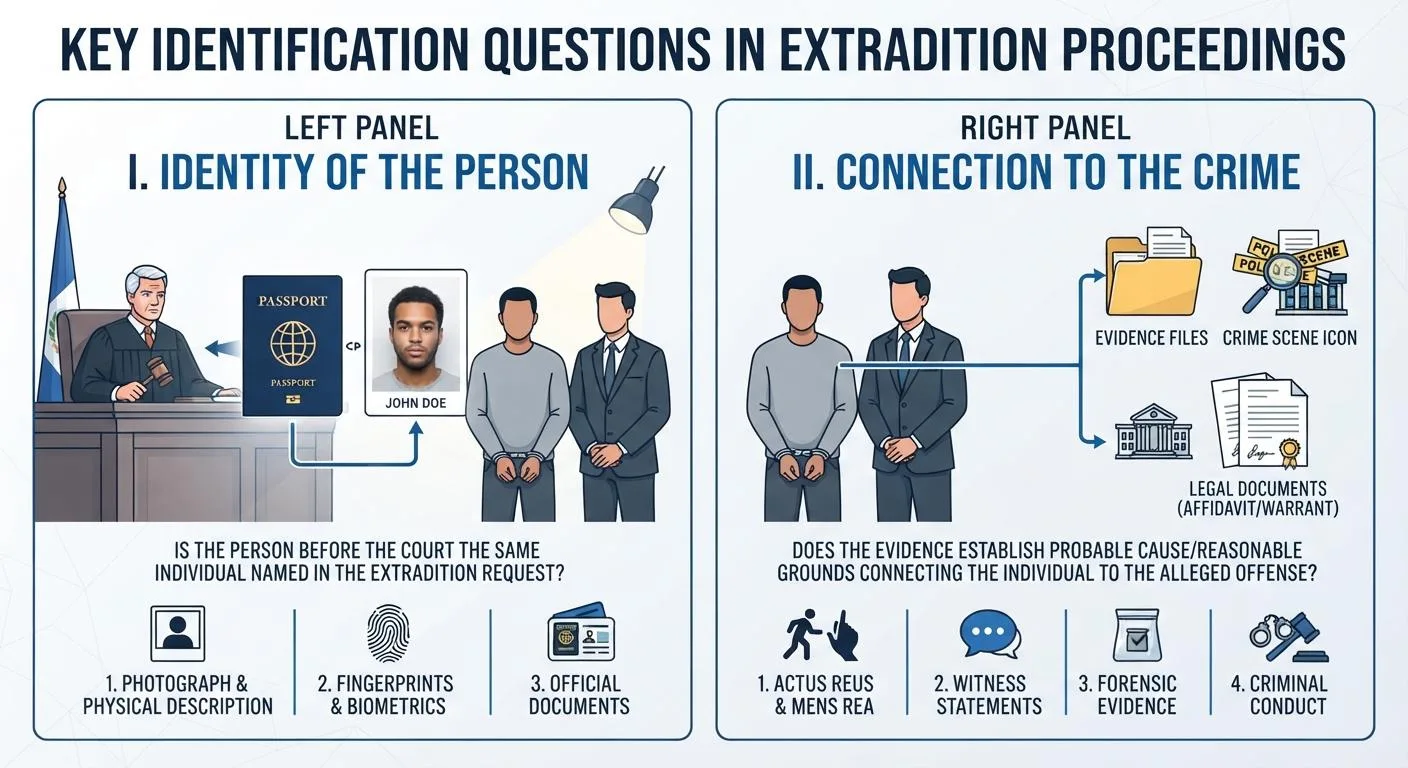
Courts may examine documentary evidence, biometric comparisons and competing claims when determining whether a detained individual is the person sought by authorities.
Washington, DC, November 3, 2026 — International extradition proceedings can become more complicated when a detained individual disputes being the person named in a foreign request, requiring courts to examine identification evidence within the legal framework governing the proposed surrender.
The question involves more than whether two records contain matching names, because authorities may rely on photographs, fingerprints, witness accounts and personal histories to connect the individual before the court with the person sought abroad.
An identity determination also differs from a finding of guilt, making it essential to distinguish whether authorities have detained the requested person from whether that person committed the offense underlying the foreign investigation or prosecution.
For families, legal representatives and readers following international cases, understanding that distinction helps explain why an identification hearing can involve substantial evidence without resolving either the criminal allegations or every remaining question about extradition.
Identity Is a Separate Question From Criminal Responsibility
An extradition court may need to address two different identification questions: whether the detained individual is the person requested by the foreign government, and whether the evidence sufficiently connects the requested person to the alleged criminal conduct.
Those questions can overlap factually, but treating them as interchangeable risks overlooking the specific objection being raised, particularly when someone accepts that foreign proceedings exist while maintaining that authorities have detained an entirely different person.
The United States Department of State explains that an extradition judge must find that the person before the court is the person sought, alongside other requirements involving the treaty, extraditable offenses and sufficient evidence of criminal involvement.
The same guidance emphasizes that an extradition hearing is not a criminal trial, meaning a ruling that identifies the detained person should not be reported as a verdict establishing guilt for the underlying foreign charges.
The Governing Jurisdiction Determines the Legal Test
International extradition does not operate through a single worldwide evidentiary standard, so an identity dispute must be examined under the domestic legislation, applicable agreement and judicial decisions governing the country where the person is detained.
In Canada, Section 29 of the Extradition Act requires the judge, in a prosecution request, to be satisfied that the individual is the person sought, alongside the statutory requirement concerning evidence sufficient to justify committal.
For a request involving the imposition or enforcement of a sentence, the Canadian provision separately requires satisfaction that the individual is the person who was convicted, subject to provisions addressing convictions entered in the person’s absence.
These distinctions show why a general description of extradition cannot replace analysis of the actual proceeding, particularly when advisers compare cases involving different countries, different procedural stages, or different reasons for seeking a person’s surrender.
Names and Physical Characteristics Can Both Be Evidence
Canada’s statutory provisions on evidence of identity expressly recognize similarities between names and similarities between physical characteristics and a photograph, fingerprint or other description as evidence connecting the person before the court with the requested individual.
The provision matters because identification can involve several forms of comparison, rather than depending exclusively on a passport number or an exact spelling match between the detained person’s current documents and the foreign request.
However, describing a similarity as evidence does not mean that every similar name conclusively establishes identity, and the statutory wording should not be presented as eliminating the need to consider the identification question in the particular proceeding.
For a practical review, the key question is what each comparison adds to the identification, including whether apparently separate records provide independent support or simply repeat information from the same original source without additional verification.
A Scottish Case Illustrates How Evidence Can Converge
A documented example appears in the Scottish court’s November 2022 decision concerning Nicholas Rossi, in which the individual appearing as Arthur Knight disputed being the person the United States sought to extradite for proceedings in Utah.
The published identification judgment described evidence from fingerprint examiners, healthcare staff, police officers and other witnesses, demonstrating how the court examined several sources when considering the claimed distinction between the detained individual and the requested person.
The sheriff ultimately found that the individual was Rossi, relying on fingerprint, photographic and tattoo evidence together with evidence concerning names, while applying the balance-of-probabilities standard identified in the judgment for that particular statutory question.
Crucially, the decision expressly separated identification from both guilt and the later question of whether extradition should occur, making the case an illustration of a defined procedural determination rather than a substitute for the underlying criminal proceedings.
Biometric Comparisons Require Attention to Their Foundations
Fingerprint comparisons can provide important identification evidence, but evaluating a comparison also requires understanding the records being compared, how they were attributed to particular people and what the examiner actually concluded from the available material.
Research published by the National Institute of Standards and Technology concerning latent fingerprint analysis identifies human factors that can affect examination, including training, judgment and quality controls, reinforcing the importance of examining methodology rather than invoking scientific certainty.
That research concerns latent print analysis, which should not automatically be equated with every comparison of recorded fingerprints in an extradition case, because the nature and quality of the material can differ between these settings.
A useful evidentiary review therefore asks whether the comparison addresses the disputed identity, while distinguishing a supported expert conclusion from the broader assertion that every record associated with the same person must be accurate.
Authentication and Persuasive Weight Are Different Questions
Foreign documents can raise questions about both admissibility and persuasive value, so it matters whether a court may receive a record and whether that record convincingly establishes the particular identification asserted by authorities.
In United States extradition proceedings, Section 3190 provides a statutory route for admitting properly authenticated depositions, warrants and other papers, including copies, with specified diplomatic or consular certification serving as proof of the required authentication.
That provision helps explain why an extradition hearing may rely heavily on documentary material, but the admission of a document should not be confused with a finding that every inference drawn from its contents is necessarily correct.
For example, a properly authenticated record can still require interpretation about which individual it describes, especially where the dispute concerns an attached photograph, an identifying number or the relationship between an earlier record and a later amendment.
Discrepancies Need Specific Explanations
A difference between records should prompt a focused question about its origin and significance, rather than an immediate assumption that it proves either mistaken identity or deliberate deception by the person whose extradition is being requested.
A useful review might distinguish a spelling variation from a conflicting date of birth, then examine whether the underlying documents explain the difference or whether the inconsistency affects the proposed connection between the person and the request.
Similarly, several documents repeating the same biographical detail may appear mutually reinforcing, yet their usefulness depends partly on whether they were independently created or copied from a common record containing the very information under dispute.
These are questions for evidence-based assessment rather than automatic rules, because the significance of any discrepancy depends on its context, the other identification evidence and the legal standard governing the court’s decision in that jurisdiction.
A Red Notice Does Not Resolve the Court’s Task
An INTERPOL Red Notice can bring an individual to the attention of authorities, but INTERPOL describes it as a request to locate and provisionally arrest someone pending extradition, surrender or comparable legal action, rather than an international arrest warrant.
Member countries apply their own laws when deciding whether to arrest a person, and the notice may contain identifying details such as names, dates of birth, photographs and fingerprints where those materials are available to authorities.
The distinction matters because information distributed through a notice can support identification efforts without replacing the domestic legal process that governs detention or the subsequent assessment of an extradition request by the competent national authorities.
Public reporting should therefore distinguish the existence of an alert from a judicial finding about identity, while avoiding language that suggests an international police communication independently establishes either guilt or a final entitlement to surrender.
The Opportunity to Present Evidence Has Procedural Limits
A person disputing identity needs advice on how to properly raise that issue in the relevant proceedings, because an extradition hearing may not offer the same evidentiary opportunities or procedural rules as an ordinary criminal trial.
The United States Department of Justice explains that the Federal Rules of Evidence and Federal Rules of Criminal Procedure do not apply to extradition proceedings, so assumptions based on familiar domestic trial procedures may be misleading in this setting.
Its guidance also distinguishes judicial certification from the Secretary of State’s surrender decision and identifies habeas corpus proceedings as a way to challenge detention after certification, rather than treating certification as an ordinarily appealable criminal judgment.
The practical implication is that potentially relevant records should be discussed promptly with counsel, who can assess their admissibility, purpose and procedural timing without assuming that every proposed factual dispute can be litigated in the same manner.
A Different Legal Name Does Not Answer the Identity Question
A person’s use of a different name should be analyzed through the relevant documents and circumstances, because the question before an extradition court concerns whether the detained individual is the requested person, whatever name currently appears on their paperwork.
A lawful name-change order can help explain the relationship between earlier and later records, but its existence should not be mistaken for a judicial determination that the person has no connection to proceedings conducted under an earlier name.
Readers considering commercial services, including those described on Amicus International Consulting’s new-identity services page, should distinguish the proposed administrative procedure from any claim about how a court would determine identity in an existing extradition matter.
The appropriate review asks what change an authorized government body would recognize and how existing records would connect, rather than assuming promotional language about a fresh start determines the legal effect of the proposed arrangement.
Preparation Should Focus on Verifiable Records
Where mistaken identity is genuinely alleged, an organized record can help counsel identify the precise disagreement, including which photograph, identifying number, biographical statement or historical document is said to connect the detained individual with the foreign case.
Useful preparation centers on preserving existing documents and explaining their origins, while allowing legal representatives to determine which materials address the relevant issue and how they can be obtained, authenticated and presented through the applicable procedures.
If expert assistance is being considered, the proposed task should be defined carefully, such as assessing a particular comparison or explaining an apparent inconsistency, rather than asking an examiner to endorse a broad conclusion unsupported by the available material.
Families can assist by keeping a clear chronology of documents and official communications, while avoiding alterations or speculative explanations that could obscure the difference between facts supported by records and assumptions made after the detention occurred.
An Identity Finding Does Not Decide Every Extradition Issue
A finding that the detained individual is the requested person answers an important question, but readers should still identify which remaining requirements or objections the court or another decision-maker must decide under the governing extradition framework.
Conversely, an unresolved identification dispute should not be described as proof that the foreign allegations are fabricated, because the accuracy of the detention and the merits of the underlying criminal case remain distinct subjects requiring their own analysis.
Responsible coverage should state what the court decided, what evidence it considered, and what remains unresolved, especially when an early hearing attracts attention that could lead readers to mistake an identification ruling for a final extradition decision.
The central lesson is that identity disputes require careful comparison of evidence within a specific legal process, with documentary records, biometric findings and competing explanations assessed for what they actually establish about the person before the court.