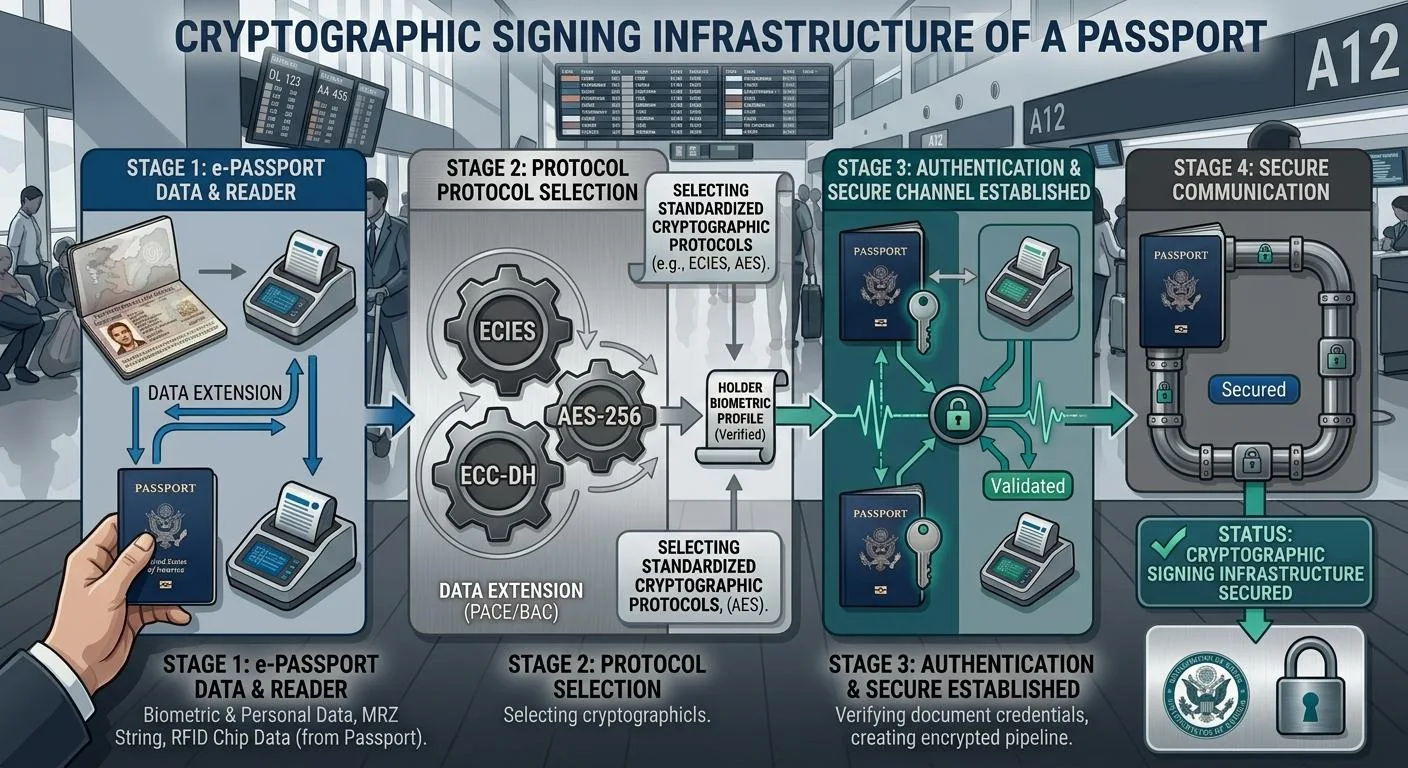
Government-issued signing credentials let inspection systems verify whether protected chip data has changed since document personalization.
Washington, DC, October 19, 2026 — Digital signatures are one of the most important security layers in an electronic passport because they let compatible inspection systems determine whether protected chip information has changed and whether it is tied to the issuing authority’s cryptographic infrastructure.
Unlike an ordinary electronic copy of a photograph or passport number, digitally signed passport data carries cryptographic evidence that border authorities can evaluate during inspection, helping detect unauthorized changes that may not be visible through physical examination alone.
Digital Signatures Protect Data Integrity
When an electronic passport is personalized, the chip processes selected information through cryptographic mechanisms that let the issuing authority create a digital signature for the document’s protected electronic contents.
That signature lets compatible systems determine whether the relevant data remains in the same state it was in when it was signed after personalization, because unauthorized modification can cause the cryptographic verification process to fail.
The International Civil Aviation Organization’s machine-readable travel document framework defines the broader international architecture supporting these electronic travel documents, establishing standardized structures for electronic passport data and authentication.
The security value therefore comes not from making the chip impossible to read, but from making unauthorized alteration detectable when inspection systems perform the appropriate cryptographic checks against trusted issuing-country credentials.
A Digital Signature Is Not an Image of a Handwritten Signature
The phrase digital signature can be confusing because it does not refer to a scanned version of a passport official’s handwritten name or a visible signature printed inside the booklet.
Instead, the term describes a mathematical cryptographic mechanism created using private signing credentials controlled within the passport-issuance infrastructure and verified through corresponding public-key information available to authorized inspection systems.
This process allows computers to evaluate the relationship between the stored passport data, its cryptographic signature and the trusted certificate hierarchy associated with the government responsible for issuing the document.
Because the mechanism operates mathematically, inspection does not depend upon a border officer visually recognizing a government official’s signature or manually comparing handwriting samples across international passport systems.
The Issuing Authority Uses Protected Signing Credentials
Governments running electronic passport programs maintain cryptographic signing infrastructure that lets authorized systems sign passport information during the document-personalization and issuance process.
The private signing credentials used for this purpose must remain protected because possession of legitimate signing capability could otherwise undermine confidence in electronic document authentication.
Inspection systems do not need access to those private signing keys because digital-signature technology allows verification through corresponding public information distributed through trusted certificate channels.
This separation between private signing and public verification lets many border systems authenticate documents without distributing the sensitive government credentials needed to create legitimate signatures.
Hashes Help Detect Changes to Stored Information
Electronic passport authentication uses cryptographic hash functions to create compact mathematical representations of protected data stored within particular electronic data groups.
Even a small change to the underlying information, such as altering part of a stored image or biographical record, typically produces a substantially different cryptographic hash value.
The passport’s digitally signed security information protects the expected values, allowing inspection software to compare calculated values against those associated with the original personalization process.
When the values do not match, the system has evidence that protected electronic information may have changed or that the stored data does not match the signed security structure.
The Document Security Object Organizes Authentication Information
An important electronic component within the passport is the Document Security Object, which contains information supporting integrity verification across protected data groups stored within the chip.
The security object includes cryptographic hashes for those data groups and carries a digital signature created through the issuing authority’s document-signing infrastructure.
A compatible inspection system can validate the signature, then compare the stored hash values with newly calculated values from the data retrieved during the current reading session.
This process lets the system determine whether electronically protected information matches what was originally signed when the passport was personalized.
Passive Authentication Checks the Signature
The process commonly known as passive authentication lets compatible readers verify the digital signature associated with electronic passport data without requiring the passport chip to perform an active challenge-response operation for that check.
The reader retrieves the protected electronic information, validates the signature using appropriate certificate information and compares the relevant cryptographic hashes with the data groups currently stored inside the passport.
When those checks succeed, the system gains strong evidence that the signed chip data has not been modified since the issuing authority completed the relevant electronic personalization process.
Successful passive authentication therefore addresses data integrity and signing provenance, although additional procedures remain necessary to evaluate the physical passport and confirm the identity of the person presenting it.
Certificate Chains Connect the Passport to the Issuing Authority
Digital-signature validation depends on a chain of cryptographic trust rather than simply accepting whatever certificate is stored alongside the passport data.
Document-signing certificates connect to higher-level certificate structures controlled by the issuing authority, allowing inspection systems to verify whether the signature ultimately traces to a trusted governmental source.
This hierarchy scales to validate large numbers of passports because individual documents don’t need to be manually registered with every foreign border authority.
Instead, trust can be established through recognized country-level certificate infrastructure and the properly issued document-signing credentials beneath it.
Country Signing Certification Authorities Anchor Trust
At the national level, electronic passport trust commonly relies on a Country Signing Certification Authority, a high-level cryptographic trust anchor within the issuing government’s electronic travel-document infrastructure.
Document Signer Certificates used during passport personalization can be validated against this national trust structure, allowing foreign inspection systems to determine whether the signing credentials connect to the expected issuing authority.
This structure separates the high-level country trust anchor from the operational certificates used to sign individual passport batches or generations.
Maintaining that hierarchy helps governments manage credential changes and operational security without requiring every passport to be individually associated with the highest-level national private key.
The ICAO PKD Supports International Certificate Exchange
To reliably authenticate electronic passports, foreign border systems need trustworthy access to certificate information tied to the issuing country’s passport infrastructure.
The ICAO Public Key Directory supports participating authorities by facilitating the international exchange of certificates and related information used when validating electronic machine-readable travel documents.
This shared infrastructure reduces dependence on thousands of separate bilateral certificate exchanges, giving participating governments a more scalable way to obtain the cryptographic material needed for cross-border verification.
The PKD does not issue passports, but it plays an important supporting role by helping inspection authorities obtain the information needed to evaluate signatures created by participating document issuers.
Successful Chip Reading Is Not Signature Validation
A smartphone or border reader may successfully communicate with an electronic passport and display the holder’s name, facial image or document number without necessarily completing full cryptographic validation of the stored information.
This distinction matters because retrieving data shows that information exists on a responsive chip, while digital-signature validation confirms that the expected governmental infrastructure signed the protected information and that it remains unchanged.
Applications can vary widely in the authentication procedures they implement, so it’s important to distinguish basic NFC reading from more comprehensive electronic passport verification.
Travelers seeking a broader explanation of these separate security layers can review the Amicus International Consulting guide to modern passport security and counterfeit detection.
A Valid Signature Does Not Prove the Traveler Is the Holder
Cryptographic validation verifies the electronic document, but it does not independently confirm whether the person at the border is the person represented by that passport.
Someone could present a genuinely issued passport with completely intact electronic data, but not its legitimate holder, creating a separate identity-verification problem.
Border authorities therefore compare the traveler with the passport portrait through human inspection or automated facial comparison, depending upon the procedures and technology used at the crossing.
Document authentication and traveler authentication work together, but they answer different questions and should not be treated as interchangeable security processes.
Digital Signatures Do Not Replace Physical Inspection
A valid electronic signature also does not establish that every physical page, hologram, stitch or security feature within the passport booklet remains original and undamaged.
Authorities may still inspect laser engraving, polycarbonate construction, security paper, ultraviolet features and binding when circumstances require closer examination of the physical travel document.
This layered approach matters because electronic and physical integrity can raise separate security questions, even though they ultimately concern the same passport.
A comprehensive assessment therefore considers whether physical construction, electronic data and traveler identity all remain consistent with one another.
Unauthorized Data Modification Can Break Verification
One of the central strengths of digital signatures is that altering protected electronic information after signing should create a mismatch during subsequent cryptographic verification.
If someone changed a stored facial image or biographical record without possessing the legitimate governmental signing credentials required to recreate the associated signature, passive authentication would ordinarily detect that the data no longer matches the protected security information.
This characteristic creates a substantial difference between electronically signed identity data and ordinary files that can be edited and saved without leaving comparable cryptographic evidence.
The passport chip therefore becomes more than digital storage because its information participates in an authentication framework designed specifically to expose unauthorized modification.
Copying Data Is Different From Creating a Valid Government Signature
Electronic information can theoretically be copied between storage devices, but copying names, photographs and other data does not automatically reproduce the governmental trust relationships required for authentic electronic passport validation.
An inspection system focused only on whether readable information appears could miss that distinction, while proper cryptographic verification checks whether the protected data carries a signature that validates through trusted issuing-country credentials.
This makes digital signatures important because they prevent attempts to treat an ePassport chip as an ordinary contactless memory device whose contents could be duplicated without consequence.
Government trust infrastructure therefore becomes as important as the data itself when determining whether electronic passport information can be authenticated.
Expired or Revoked Certificates Require Proper Handling
Cryptographic certificate systems evolve because signing credentials have defined operational periods and may need replacement when governments update infrastructure or respond to security concerns.
Inspection systems therefore need appropriate certificate-management procedures rather than assuming that one static collection of public keys will remain sufficient indefinitely.
Historical information may also remain necessary because a passport signed several years earlier can still be valid even after the issuing authority has begun using newer signing certificates for more recent documents.
Reliable verification depends on maintaining the trust information needed to evaluate when the passport was generated and issued.
Digital Signatures Support Automated Border Processing
Automated border gates benefit significantly from electronic signatures because machines need objective technical methods to assess document data without relying entirely on a human officer’s visual judgment.
A compatible system can read the passport, validate protected electronic information and then use the authenticated facial image within a separate biometric comparison against the traveler.
These processes can occur rapidly, allowing airports and border authorities to process large numbers of passengers while retaining cryptographic checks that visual inspection alone cannot provide.
Automation therefore makes the electronic signature particularly valuable because it converts trust in government documents into a form computerized inspection systems can evaluate consistently.
Authentic Data Can Still Produce an Immigration Alert
A passport can pass digital-signature validation yet still trigger a separate alert in immigration or security databases because cryptographic authentication verifies document data rather than the traveler’s overall admissibility or legal status.
The document may be genuine and unchanged, yet reported lost, stolen, canceled, or linked to another administrative condition stored outside the passport chip.
This distinction demonstrates why electronic passport authentication should not be confused with a complete border-security decision.
Government databases, immigration rules, biometric checks and physical document examination can all contribute additional information after the digital signature has been successfully validated.
Cryptographic Validation Strengthens Cross-Border Trust
Passports present a unique international security challenge because one government must routinely evaluate identity documents that another government created and personalized thousands of miles away.
Digital signatures help bridge that trust gap by letting the issuing authority attach cryptographic evidence to protected electronic information and letting foreign inspection systems validate that evidence through recognized certificate infrastructure.
This process does not require foreign officers to contact the issuing government manually every time a passport reaches a border checkpoint.
Instead, standardized cryptographic mechanisms allow much of the document-integrity assessment to occur automatically within seconds during ordinary inspection.
Digital Signatures Protect Information Rather Than Appearance
Traditional passport security focuses heavily upon physical characteristics such as printing, materials and optical effects, while digital signatures protect the integrity and provenance of electronic information stored within the chip.
The two approaches complement one another because a visually sophisticated counterfeit can still fail cryptographic validation, while electronically authentic data does not eliminate the need to inspect suspicious physical construction.
Modern passport security is stronger because these technologies address different attack surfaces rather than relying on a single universal security feature.
Each successful independent check adds evidence, while contradictions between layers give authorities reasons to conduct further examination.
Government Signing Credentials Create the Foundation
The effectiveness of electronic passport signatures ultimately depends upon governments protecting the private cryptographic credentials used within their document-signing infrastructure and distributing trustworthy public certificate information to inspection authorities.
When that infrastructure is properly managed, foreign border systems can verify whether protected data matches a legitimate signing hierarchy without accessing the sensitive private credentials used to create signatures.
This separation between protected signing capability and widely distributed verification information is a fundamental principle of modern public-key cryptography.
It lets electronic passports carry government-verifiable information across borders while keeping the most sensitive cryptographic secrets within controlled issuing environments.
Digital Signatures Make Electronic Alteration Detectable
The purpose of passport digital signatures is not to conceal the holder’s name, photograph or ordinary travel-document information, because much of that information already appears visibly on the passport data page.
Their primary security contribution is allowing inspection systems to verify that protected electronic information matches what the issuing authority originally signed during document personalization.
When that cryptographic evidence aligns with consistent physical security features and a successful biometric comparison, authorities have several independent reasons to trust the document and identity presented.
For legitimate travelers, this process usually happens invisibly during an electronic inspection, yet the underlying digital signature provides one of the strongest mechanisms for protecting passport chip information from undetected modification after issuance.