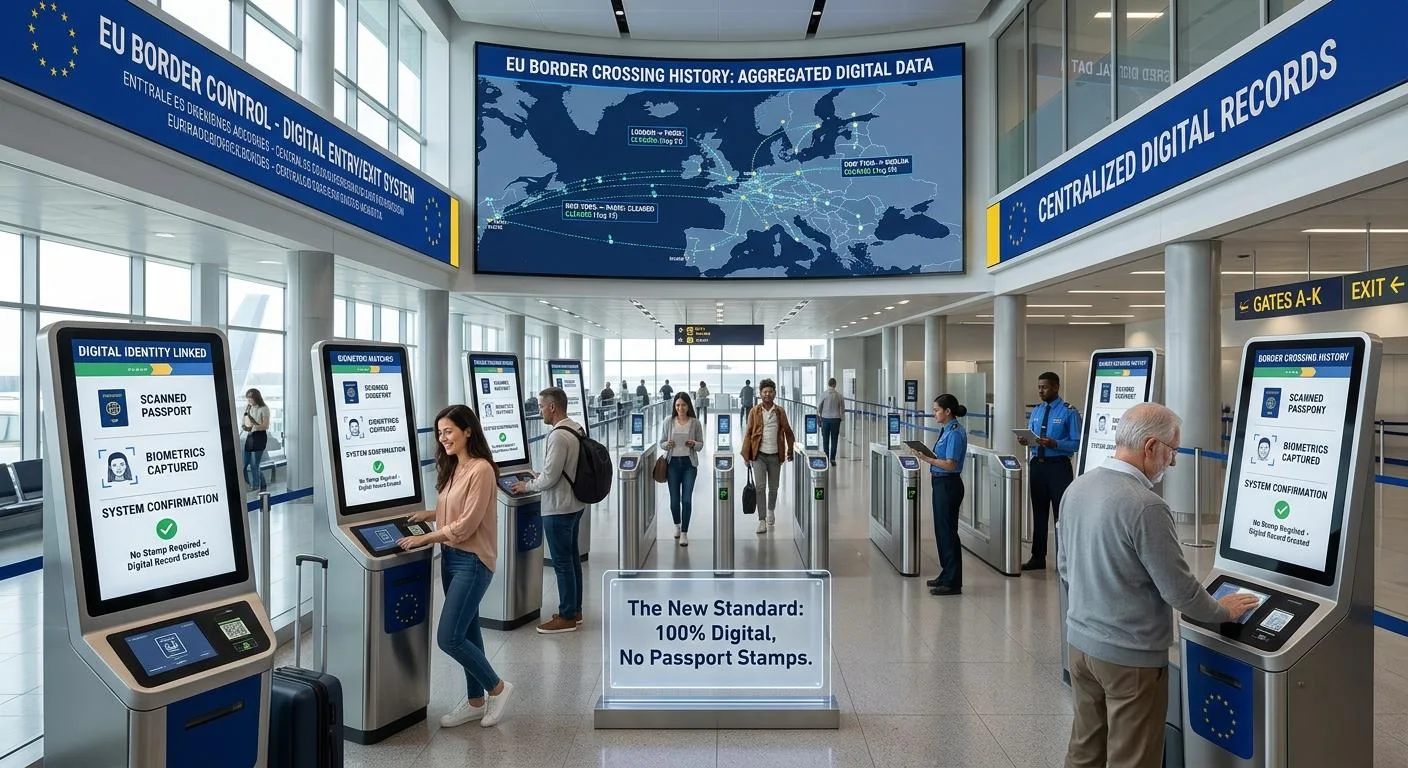
Facial images and fingerprints raise questions about access, retention and the treatment of different travel records, as Europe replaces routine passport stamping for many short-stay visitors with centralized digital records linking identity, biometrics and border-crossing history.
WASHINGTON, DC, October 26, 2026. Europe’s Entry/Exit System has transformed how millions of non-European travelers are recorded when crossing the Schengen Area’s external borders, replacing traditional passport stamps with electronic files containing travel-document information, entry and exit events, facial images, and, where required, fingerprints.
Europe Has Moved From Passport Stamps to Digital Border Records
The Entry/Exit System, commonly known as EES, became fully operational across participating external Schengen border crossing points on April 10, 2026, following a progressive deployment that began on October 12, 2025 and gradually introduced biometric registration throughout twenty-nine participating European countries.
The European Commission describes the system as an automated information platform designed to register non-European nationals traveling for short stays, recording their names, travel-document details, facial images, fingerprints and the dates and locations associated with their entries, exits or refusals of entry.
Unlike the familiar physical stamp placed into a passport booklet, the EES creates a centralized digital history capable of showing when an eligible traveler entered participating territory, when that individual departed and whether the authorized period of stay appears to have been exceeded.
That change means the border encounter no longer ends with a visible mark inside the passport, because information associated with the crossing can remain within the EES Central System long after the traveler has left the airport, seaport or land-border inspection area.
The System Does Not Apply to Every Traveler Entering Europe
The EES primarily applies to non-European Union nationals traveling for short stays in participating countries, while citizens of European Union member states and nationals of Iceland, Liechtenstein, Norway and Switzerland are not registered within the system when crossing the covered external borders.
Certain other travelers are also exempt, including specified holders of long-stay visas or residence permits and qualifying non-European family members of European citizens who possess the appropriate residence documentation, demonstrating that nationality alone does not determine whether EES enrollment occurs.
A Canadian tourist arriving for a short visit can therefore be registered within EES, while another Canadian holding an eligible long-term residence permit issued by a participating country may fall outside ordinary EES registration and instead follow the border procedure applicable to that residence status.
These distinctions are important because visually similar travelers standing before the same airport equipment can encounter different biometric requirements depending upon citizenship, residence documentation, family status and the particular legal basis under which they are entering participating European territory.
Facial Images and Fingerprints Create a Persistent Identity Record
For travelers who meet EES requirements, biometric information creates a more durable link between the individual and the travel record than a traditional ink stamp, because facial images and fingerprints help authorities determine whether subsequent border crossings involve the same person.
The European Commission says border authorities check fingerprints and facial images against biometrics already stored in the system at subsequent crossings, allowing them to detect cases where the same person may try to travel under different documents or claimed identities.
By August 2026, the Commission reported that EES had registered more than 150 million entries and exits and helped authorities identify cases where travelers attempted to cross European borders using multiple identities or documents associated with different names.
That operational use shows why biometric information is not collected solely to speed a single airport interaction, because EES value depends substantially on the ability to compare a future traveler with biometric records created during previous crossings.
Enrollment and Later Verification Serve Different Purposes
The first EES registration generally creates the individual biometric file needed for future processing, while subsequent crossings can use stored information to help confirm that the traveler presenting a passport corresponds with the person previously registered under that identity.
This distinction means an initial border interaction can involve more extensive biometric collection than a later crossing, because once an individual record exists, authorities can use newly captured information to verify the traveler against information already maintained within the central system.
The exact traveler experience can vary by border location and equipment, particularly as participating countries increasingly use self-service terminals and automated gates, but the central concept remains that biometric enrollment supports repeated identity verification rather than a single isolated camera comparison.
The European Commission’s Entry/Exit System information explains that the platform enables wider use of automated border controls and self-service systems while maintaining centralized information about eligible travelers and their movements across participating external borders.
Three Years Is a Key Retention Period
European legislation sets a three-year retention period for ordinary entry, exit, and refusal-of-entry records linked to an individual EES file, calculated from the applicable exit event or refusal of entry recorded in the centralized system.
The individual file linked to those crossing records is generally retained for three years and one day after the traveler’s last recorded exit or refusal, when no subsequent entry is registered during the period specified by the governing regulation.
These rules show that biometric border information does not simply disappear after the traveler passes through an airport gate, because the system is designed specifically to preserve identity and crossing information long enough to support future verification and immigration administration.
The retention period also demonstrates why EES should be understood as a border-record system rather than merely an airport facial-recognition application, since a temporary camera photograph used only for an instantaneous comparison would not require a multi-year statutory data lifecycle.
Missing Exit Records Can Lead to Five-Year Retention
The regulation provides a longer retention period when the system does not contain an exit record after the traveler’s authorized period of stay expires, allowing relevant information to remain stored for five years after that period ends.
This longer period supports the EES objective of identifying overstayers because authorities need sufficient historical information to determine that a traveler entered, reached the end of an authorized stay, and apparently failed to produce a corresponding departure event within the system.
The five-year rule shows how retention depends on what happens after the original biometric enrollment, meaning the same facial image and fingerprint data can remain available for different periods depending on the traveler’s subsequent recorded immigration history.
A biometric record therefore matters beyond identity verification alone because it links to a chronological border history that helps authorities calculate lawful stay periods and identify situations that require additional immigration examination.
Refusal Records Also Remain Part of the System
EES records refusals of entry as well as successful entries and departures, allowing border authorities at other participating locations to see that a traveler previously attempted to enter and was refused under circumstances documented within the system.
During the progressive deployment, the European Commission reported that tens of thousands of refusals had already been registered, including cases involving inadequate travel justification, expired or fraudulent documents, and individuals identified as presenting security concerns under applicable border procedures.
This means the EES record is not merely a chronological list of successful vacations or business trips; it can also document adverse border outcomes that may become relevant when authorities evaluate a later crossing by the same individual.
Biometric identifiers strengthen that continuity by helping authorities determine whether someone presenting a different document or identity matches a person whose earlier refusal already exists in the centralized European record.
Access Is Broader Than the Officer Standing at the Airport
The information collected during enrollment does not remain confined to the workstation or border gate where the traveler originally supplied fingerprints and a facial image, because authorized border and immigration authorities across participating countries can require access to relevant EES information for their official duties.
That cross-border availability represents one of the system’s principal operational advantages, because a person registered when entering through one participating country can later depart through another location while authorities continue working from the same centralized identity and crossing history.
European legislation nevertheless restricts access by authorized purpose and requires the system to apply security and accountability mechanisms, rather than functioning as an unrestricted government repository available to anyone with institutional credentials.
The centralization therefore increases both operational capability and privacy significance, because biometric information gathered during one airport interaction can become accessible during legitimate border procedures occurring thousands of kilometers away within the same participating framework.
Law-Enforcement Access Exists Under Specific Conditions
EES legislation also permits designated national law-enforcement authorities and Europol to seek access for specified purposes involving serious crime and terrorism, but procedural conditions govern that capability rather than allowing ordinary, unrestricted law-enforcement searches of every traveler’s border record.
Requests involving Europol require designated channels and authorization procedures, and the governing legislation requires verification that consultation conditions have been met before EES information can be transmitted to the requesting authority.
This distinction matters because simply stating that police can access EES can create the misleading impression that every officer has routine browsing access to biometric travel records, when the legislation instead establishes defined purposes, designated authorities, and procedural controls around consultation.
At the same time, the possibility of law-enforcement access underscores why retention matters from a privacy perspective, because a biometric record stored for border administration can become relevant to another government function when statutory conditions permitting access are satisfied.
EES Is Not the Same as Every Other European Biometric Database
Europe operates several large information systems for immigration, asylum, security, and law enforcement, and travelers can easily confuse EES with databases such as the Schengen Information System, Visa Information System, or Eurodac because several platforms can contain identity information or biometrics.
The EES has its own legal purpose, traveler population, access controls, and retention schedule, so a biometric record created for short-stay border entry should not automatically be treated as equivalent to an asylum fingerprint record or a security alert stored elsewhere.
This distinction also matters when discussing deletion because erasure from EES does not necessarily delete information independently maintained in another lawful European database created for a different purpose and governed by another regulation.
The architecture therefore resembles other modern border environments in which one traveler can generate several legally distinct records even though those records may contain overlapping personal information such as a name, passport number or facial image.
Local Deletion and Central Retention Are Different Questions
Travelers interacting with a self-service kiosk may see their photograph disappear from the screen immediately after processing, but that user-interface behavior says little about whether the information has already been transmitted into EES and incorporated into the traveler’s central record.
The EES is deliberately designed around centralized registration, so removing a temporary image from the physical terminal does not erase the biometric information the system must preserve for later identity verification and border administration.
This distinction reflects a broader principle emerging across modern airports: endpoint equipment can minimize local storage while secure government systems preserve authorized records under formal retention schedules that extend well beyond the traveler’s interaction with the machine.
A privacy notice explaining that a kiosk clears its temporary memory should therefore never be interpreted as a statement that the corresponding EES entry, facial image or fingerprint record has simultaneously disappeared from the central European system.
A Passport Photograph and an EES Facial Image Are Separate Records
An electronic passport contains a facial portrait supplied during document issuance, while EES can capture another facial image during border processing, creating two separate biometric records even though the system may use both to support identity verification.
The passport portrait remains governed by the issuing country’s passport laws and records policies, while the EES image falls under the European regulation establishing the centralized entry and exit system and its associated retention requirements.
Deleting one record therefore does not erase the other, just as replacement of a passport does not automatically eliminate an EES history already associated with the traveler’s previous crossings and biometric enrollment.
Amicus International Consulting’s guide to how modern passports help detect counterfeits and protect identity explores the relationship among passport photographs, electronic chip authentication, and border facial comparison, explaining why modern identity verification relies on several independent information sources and security layers.
Facial Recognition Does Not Decide Admissibility Alone
The presence of facial images inside EES does not mean an algorithm independently decides whether someone may enter Europe, because border authorities must still evaluate passports, visas where required, travel purpose, length of intended stay and other legal conditions governing admission.
A successful biometric comparison primarily strengthens confidence that the person standing before the inspector matches the identity represented in the traveler’s existing EES file and the travel document presented.
Authorities can still refuse entry for reasons unrelated to biometric similarity, including inadequate documentation or failure to satisfy applicable entry conditions, which explains why EES records contain refusals even when the individual’s identity itself is not disputed.
Biometrics therefore support the legal border decision rather than replace it, making EES simultaneously an identity system, travel-history system, and administrative tool without turning facial recognition into an autonomous immigration authority.
Automated Processing Still Produces Government Records
A traveler who moves quickly through a self-service terminal or automated border gate may experience the interaction as less formal than an officer stamping a passport, although the digital process can create a more structured, searchable government record than a traditional physical stamp.
The former stamp primarily showed a human reader that a particular passport had crossed a particular border, while EES links that event to centralized identity information that participating countries can retrieve and compare during later crossings.
That shift can improve consistency in determining authorized stay periods while also increasing the importance of accurate data governance, because errors within a centralized system can potentially affect processing at multiple border points rather than remaining confined to one physical passport page.
Travelers therefore have a strong interest in the accuracy and security of EES information, especially when identity details, biometric characteristics, and travel chronology are linked in one long-lived government file.
Different Traveler Categories Remain Important
Although headlines often describe EES as Europe’s new biometric border system, the rules include exemptions and distinctions that prevent the platform from operating as a universal biometric registry of everyone crossing a European external border.
EU citizens and nationals of Iceland, Liechtenstein, Norway and Switzerland remain outside ordinary EES registration, while several categories of non-European residents and qualifying family members are also exempt under the system’s current rules.
Travelers should therefore avoid assuming that seeing another passenger provide fingerprints means they will necessarily undergo the same process, because legal status can determine whether biometric enrollment occurs even when both individuals are entering through adjacent airport lanes.
Those distinctions make the traveler’s actual immigration status more informative than the border equipment’s physical appearance when determining whether EES collection and retention rules apply.
Privacy Questions Extend Beyond How Long the Data Are Stored
Retention receives considerable attention because European law specifies clear multi-year periods, yet other privacy questions include who can search the information, under which circumstances access is permitted, how corrections are handled, and what security protections prevent unauthorized disclosure.
Centralized biometric information is particularly sensitive because fingerprints cannot be changed after a breach and facial characteristics remain relatively persistent throughout a person’s life, making strong technical and administrative controls essential wherever these identifiers are maintained.
The EES legal framework therefore combines operational goals with data-protection requirements, reflecting the European Union’s broader obligation to balance immigration management and security objectives with protections governing personal information and fundamental rights.
For travelers, understanding that framework requires looking beyond the moment when a fingerprint scanner illuminates or a camera captures a face, because the most consequential privacy issues develop after those measurements become part of the central record.
Europe’s Digital Border Is Designed to Remember
The central feature distinguishing EES from a temporary airport facial comparison is ultimately its deliberate ability to remember previous crossings, because the system’s purpose depends upon maintaining enough information to recognize returning travelers and reconstruct their short-stay border histories.
That memory allows authorities to identify overstays more consistently, recognize attempts involving multiple identities and reduce reliance upon manually interpreting passport stamps accumulated across different countries and crossing points.
The same capability inevitably creates a more substantial biometric record than the traditional stamped passport produced, making retention limits, controlled access, accurate information and eventual deletion central components of the privacy framework surrounding the system.
Europe’s transition therefore represents more than technological modernization at the airport gate, because it changes the nature of the border record itself from a physical mark carried largely by the traveler into a centralized digital history maintained by participating governments.
EES Makes the Data Lifecycle Part of the Border Conversation
With EES now fully operational across participating external Schengen borders, discussions about biometric travel increasingly need to consider what happens after identity verification, rather than focusing solely on whether facial recognition and fingerprint scanners can process travelers efficiently.
For ordinary compliant travelers, current legislation generally points toward three-year retention for entry, exit and refusal records, while the unresolved absence of a required exit record can extend storage to five years under the conditions established by the governing regulation.
Those retention periods, together with controlled border, immigration and law-enforcement access, demonstrate why EES should be understood as a structured government recordkeeping system built around biometrics rather than simply another camera installed beside a passport reader.
As digital borders continue expanding, the European experience highlights a central privacy reality that will increasingly apply worldwide, because the critical question surrounding biometric travel is no longer merely whether a government can recognize a traveler, but how long that recognition remains connected to a searchable history of where and when that person crossed the border.