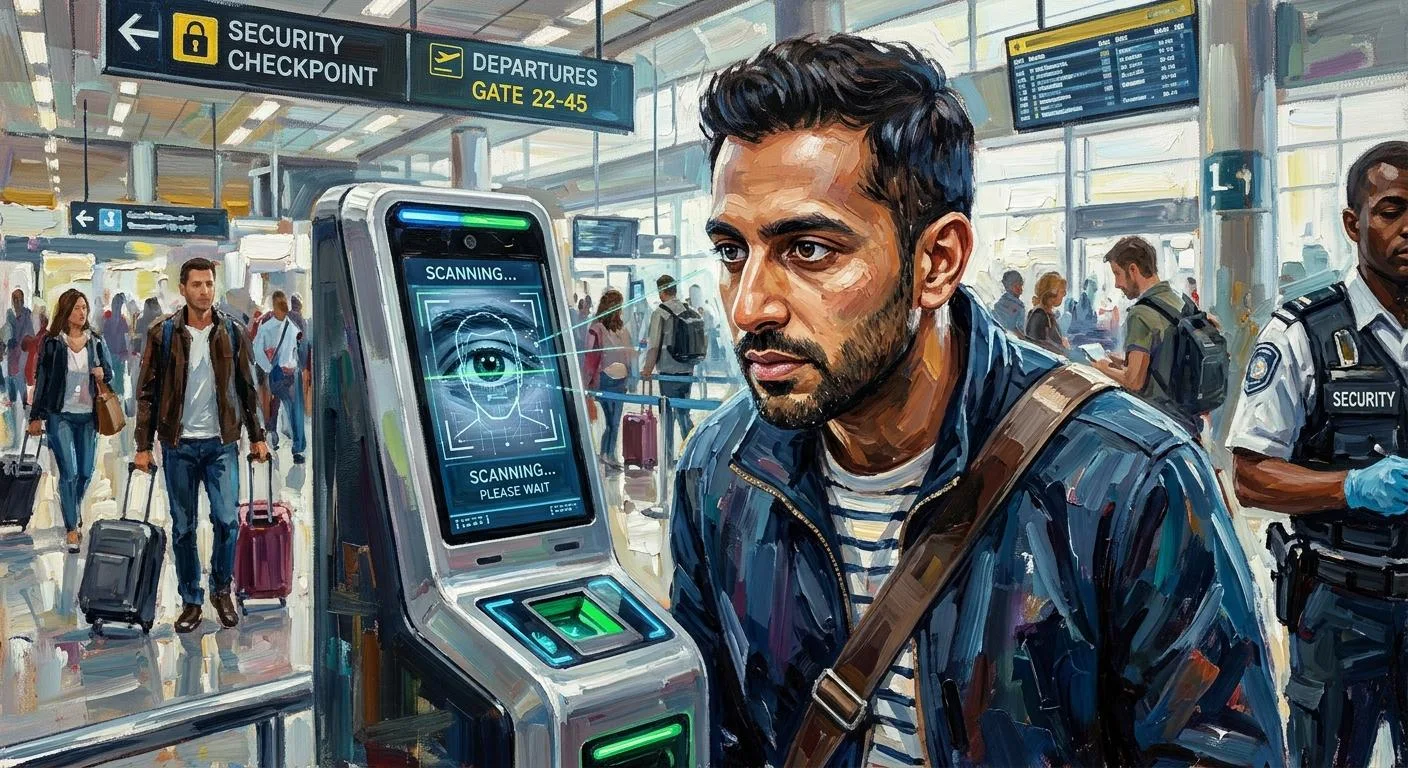
Biometric verification operates alongside reservation checks, travel document requirements and other conditions for accepting a passenger, meaning a successful facial comparison can confirm identity without independently establishing that the traveler is ticketed, properly documented or eligible to board an international flight.
WASHINGTON, DC, October 23, 2026. A successful facial recognition result at an airport gate may let a passenger move through one identity-verification step quickly, but airlines still rely on reservation records, passports, visas, security requirements, and destination-entry conditions before determining whether an individual can board an international flight.
Facial Recognition Answers a Narrow Identity Question
When an airline or airport camera captures a traveler’s face and submits the image for biometric comparison, the facial recognition process primarily determines whether the person before the camera matches an expected passenger identity.
That result can be highly useful because it allows the airline to connect the live traveler with a passenger record without requiring repeated manual comparison of the person, passport and boarding credential at every participating checkpoint.
However, identity confirmation alone does not establish that the passenger has a valid reservation, has completed required check-in procedures, holds acceptable travel documents, or meets the entry and transit requirements for the planned journey.
A successful facial match therefore resolves one important operational question while leaving several others for airline systems, government authorities and transportation personnel to evaluate separately before the aircraft departs.
The Passenger Must Still Exist in the Airline Reservation System
Before any boarding transaction can succeed, the traveler normally needs a valid reservation associated with the scheduled flight, meaning the airline’s departure control system must recognize that person as an expected passenger assigned to the appropriate itinerary.
Biometric verification can help associate the face at the gate with that reservation, but facial similarity cannot create a booking that does not exist or correct an itinerary that has been canceled, changed or otherwise removed from the flight.
The airline still needs to confirm that the passenger has been properly checked in, that the reservation remains active and that the traveler is assigned to the correct departure rather than another flight leaving from the same terminal.
This distinction shows why facial recognition serves as an identity layer within airline operations rather than replacing the broader reservation and passenger-processing systems that manage transportation eligibility.
Boarding Status Is Separate From Identity
A passenger can be correctly identified and still lack permission to board at that moment because airline systems may show that check-in remains incomplete, a seat assignment requires resolution or another operational condition must be satisfied before boarding can continue.
Gate systems therefore evaluate more than the biometric result, using the verified identity to retrieve the passenger record and determine whether that individual has the appropriate boarding status within the carrier’s departure control environment.
If the traveler has already boarded, has been rebooked, is assigned to another flight or requires assistance from airline staff, the facial match can still be accurate even though the operational response differs from simply opening the gate.
The biometric result therefore serves as a reliable link to the passenger record rather than a universal instruction to proceed with transportation.
International Travel Still Requires a Valid Passport
For most international journeys, passengers must carry a valid passport or other recognized travel document, even when facial recognition technology can automatically identify them at the departure gate.
A biometric match demonstrates that the traveler appears to correspond with an expected identity, but it does not independently prove that the passport remains valid, contains sufficient validity for the destination or satisfies other documentary conditions imposed by national authorities.
Airlines retain strong incentives to verify travel documents because carriers can face substantial operational and financial consequences when transporting passengers who lack the documentation required by the destination country.
Facial recognition therefore simplifies identity verification without eliminating the passport’s legal role as the internationally recognized credential establishing nationality and travel-document status.
Visa Requirements Remain Completely Separate
A traveler can match the government reference photograph perfectly while still lacking a visa, electronic travel authorization or other entry permission required by the destination government.
Airlines commonly verify those requirements before departure because a destination country can refuse entry to passengers who arrive without the appropriate authorization, potentially requiring the carrier to transport the person back.
The biometric boarding system does not create or extend a visa, determine whether a previous immigration permission remains valid or resolve whether the traveler’s planned activities fit the conditions attached to that authorization.
A facial match can therefore identify the passenger confidently, while airline and government systems separately determine whether that person has the permissions needed for the particular international journey.
Transit Countries Can Add Another Layer of Requirements
International itineraries can involve connections through countries that impose their own transit visa or document requirements, even when the traveler’s final destination would otherwise allow entry with the passport presented.
Airlines must therefore consider the entire itinerary, not just the destination printed prominently on the passenger’s ticket, because a traveler unable to transit through an intermediate country may not be transportable on the booked routing.
Facial recognition does nothing to resolve those legal requirements because the technology concerns identity rather than the immigration permissions associated with each border the traveler may encounter during the journey.
The airline’s document-checking systems and trained personnel remain responsible for identifying whether transit conditions create another obstacle to boarding.
Reservation Data and Biometric Identity Work Together
Biometric boarding is clearest when facial recognition is understood as a way to connect the physical traveler to an existing passenger record, not replace it.
Once the system identifies the traveler, airline software can retrieve reservation details, flight assignment, boarding status and other operational information associated with the individual expected on the manifest.
That integration can reduce repetitive document presentation because the passenger does not necessarily need to scan a boarding pass every time the system can reliably establish identity through facial comparison.
However, the airline’s underlying information still needs to show that the passenger is eligible to proceed, demonstrating that the face functions primarily as an access key to the reservation rather than the reservation itself.
Government Identity Systems Can Support the Comparison
In the United States, participating airlines and airports can connect boarding cameras with Customs and Border Protection’s Traveler Verification Service, allowing a live passenger photograph to be compared against government reference images associated with travelers expected on the flight.
CBP explains that flight manifest information can be used to assemble targeted galleries from passport, visa and previous government photographs, creating a focused comparison environment for the passengers expected at that particular departure gate.
The U.S. Customs and Border Protection biometric travel program describes how participating travel partners capture live photographs and securely submit them for government comparison, while the resulting match supports the travel process without granting unrestricted access to government biometric databases.
The airline receives the identity result it needs for passenger processing, but it still must reconcile that result with the carrier’s own reservation and document requirements before completing boarding.
A Facial Match Does Not Authenticate Every Travel Document
A biometric system can confirm that the traveler resembles the identity associated with a passport record, but document authenticity requires separate security checks to confirm the passport was legitimately issued and remains untampered.
Electronic passports contain digitally protected information that compatible inspection systems can authenticate, while airline personnel and border authorities can also examine physical document features and government databases when circumstances require additional verification.
Facial recognition therefore addresses the relationship between a person and their identity reference, while passport authentication addresses the credential’s reliability.
The distinction matters because an accurate biometric match should not be interpreted as proof that every document accompanying the traveler has automatically passed all relevant authenticity and validity checks.
Destination Admissibility Remains a Government Decision
Airlines can evaluate documentation before boarding, but the government controlling the destination border makes the final decision on whether a traveler may enter another country.
Immigration officers may consider nationality, visa status, travel purpose, immigration history, length of intended stay and other legal requirements that a departure-gate facial recognition system cannot resolve.
A traveler can therefore board successfully after passing airline identity and document checks yet still undergo additional questioning or examination upon arrival because the destination government applies its own independent immigration rules.
Biometric boarding should consequently be understood as a transportation identity process rather than as advance admission into another sovereign jurisdiction.
Security Screening Remains Another Independent Requirement
Even a perfectly identified passenger must still satisfy aviation security requirements before entering restricted areas and boarding an aircraft, because identity verification and security screening address different risks within the transportation system.
Security authorities can require screening of the traveler and baggage, review travel credentials and apply additional procedures when circumstances warrant, regardless of whether a facial comparison already confirmed the passenger’s identity.
A biometric match does not determine whether prohibited items are present, whether baggage requires inspection, or whether the traveler is subject to other security procedures.
The boarding process therefore relies on several independent layers, with facial recognition helping identify the passenger while security systems determine whether the traveler and belongings can safely enter the aircraft environment.
Baggage Issues Can Affect Boarding
Airlines also manage checked baggage under operational and security rules that remain completely independent of the biometric facial match performed at the gate.
A traveler whose luggage has been misrouted, improperly checked or associated with another itinerary can require airline intervention even though facial recognition correctly identifies the passenger standing at the departure point.
International aviation procedures can also require reconciling boarded passengers with checked baggage under certain circumstances, giving the carrier another reason to examine more than identity alone before departure.
The biometric result therefore improves one part of the passenger-processing chain while baggage systems continue operating under their own safety and operational requirements.
Payment and Ticketing Problems Can Still Block Travel
A passenger may be correctly identified yet have an unresolved ticketing issue, such as an incomplete payment, reissued itinerary or reservation change that prevents the departure control system from authorizing boarding.
Facial recognition cannot resolve those commercial conditions because the algorithm has no authority to determine whether a fare was paid correctly or whether a rebooking has been completed.
The identity result simply directs airline systems to the correct passenger record, after which the carrier must determine whether that record satisfies all financial and ticketing requirements.
This separation again reinforces the concept that a face can serve as a credential to retrieve information without replacing the information needed to complete the travel transaction.
Health or Entry Documentation Can Create Additional Requirements
Certain destinations can impose health, vaccination or other documentary requirements depending upon current public-health rules, nationality or the circumstances of travel.
Those requirements can change independently of biometric technology, meaning a traveler whose face matches successfully can still lack another document required for transportation or entry.
Airlines typically rely on destination-specific rules and government information to determine whether they must review such documentation before boarding.
Facial recognition therefore cannot replace dynamic regulatory checks because the algorithm addresses only identity similarity, not every legal condition affecting international transportation.
Passenger Name and Document Information Must Still Align
Airlines also need consistency between the traveler’s reservation, passport and government manifest information because discrepancies involving names, document numbers or other biographical details can create problems even when the facial recognition result appears strong.
A passenger who changed a name recently, obtained a replacement passport or booked a ticket using incorrect information can require manual correction before departure.
The biometric system can confirm that the person matches an identity reference, but airline and government records still need accurate biographical information tied to the journey.
This requirement highlights another reason why facial recognition cannot eliminate data-quality controls within reservation and border systems.
A Non-Match Usually Leads to Manual Verification
If the facial recognition system doesn’t produce an acceptable result, airlines generally fall back to established document procedures rather than treating the biometric failure as proof the passenger is ineligible to travel.
Lighting, image quality, changes in appearance and other ordinary factors can influence automated comparison, making conventional passport inspection an important backup when the camera cannot resolve identity reliably.
CBP’s biometric boarding framework maintains manual verification procedures when the Traveler Verification Service does not successfully identify the traveler.
This fallback preserves the passenger’s ability to demonstrate identity through established credentials and keeps the biometric system from becoming a single point of failure within the boarding process.
A Successful Match Can Still Require Manual Review
The opposite situation can also occur because an apparently successful facial recognition result does not always eliminate the need for manual intervention when another system identifies a reservation, documentation or security issue.
Airline staff may need to inspect the passport, confirm a visa, resolve a seat assignment or investigate another operational condition despite the traveler having passed the biometric comparison without difficulty.
This layered approach is deliberate because independent checks protect against different categories of error and ensure that a successful result within one system does not automatically override information generated elsewhere.
Biometric boarding works best when it reduces unnecessary manual identity comparisons while keeping other important checks intact.
Identity Confirmation Can Support Government Exit Records
For some foreign nationals departing the United States, the live photograph used during biometric boarding can also help the government confirm that the traveler has left the country.
CBP can use that departure event to update biometric entry and exit records, improving the government’s ability to distinguish travelers who departed within their authorized periods from people for whom no departure has been recorded.
This government purpose remains distinct from the airline’s immediate need to determine whether the correct passenger is boarding the aircraft.
The same facial image can therefore support two separate processes, one involving transportation and another involving immigration recordkeeping, without making those functions legally identical.
Citizenship Can Affect Image Retention
The government’s handling of the live photograph can also differ by citizenship and traveler category, even though the airline uses the same camera and boarding workflow for many passengers.
CBP states that it retains photographs of United States citizens used during biometric entry and departure verification for a comparatively short time, while photographs involving certain foreign nationals can become part of longer-term Department of Homeland Security biometric records.
The retention policy therefore does not determine whether the airline can board the passenger, because post-comparison government recordkeeping operates as another layer beyond the immediate airline decision.
Travelers should separate whether the facial match succeeded from the separate privacy question of what happens to the photograph afterward.
Airline Copies and Government Copies Are Different
Participating airlines can briefly handle the live photograph captured at the gate, while the government receives that image for facial comparison and can apply separate rules concerning its own copy.
DHS documentation requires participating travel partners to limit retention of photographs collected for the government matching service, reducing the risk that airline systems become unnecessary long-term repositories of biometric images.
The government, meanwhile, handles resulting information according to citizenship, immigration status and the legal authority associated with the particular biometric program.
This distinction shows why understanding biometric boarding requires tracking data across multiple organizations rather than asking only whether the airport camera stores the photograph.
Passport Security Continues to Matter
Facial recognition makes it easier to determine whether the person at the gate matches an authoritative identity reference, but international travel still depends on secure documents that can be independently examined when necessary.
Amicus International Consulting explains the relationship among passport materials, electronic chip authentication and biometric holder verification in its guide to modern passport security and identity protection, where these mechanisms operate as complementary layers rather than replacements for one another.
A strong facial match can help confirm the traveler matches the passport holder, while separate document authentication can help confirm the passport is genuine and its protected information remains trustworthy.
Airlines and border authorities benefit from both forms of assurance because identity and document authenticity answer different questions within the travel process.
Traveler Choice Can Affect the Identity Verification Method
CBP’s current biometric departure guidance states that travelers who prefer not to participate in facial comparison can notify an airline, airport representative or CBP officer and use conventional travel-document verification instead within the applicable program.
Choosing manual verification changes how identity is confirmed but does not remove the passenger’s obligation to have a valid reservation, passport, visa, or other documentation required for the journey.
That alternative reinforces the idea that biometric boarding is one way to complete an established identity check, not an entirely separate legal requirement that replaces every traditional boarding procedure.
Travelers should nevertheless distinguish airline biometric choices from immigration biometrics, which can be required independently under different legal authorities.
Boarding Depends on Several Systems Agreeing
The passenger ultimately boards only when multiple systems and processes align, including reservation status, identity verification, travel-document requirements, security screening and any destination-specific eligibility checks performed before departure.
Facial recognition can make the identity component faster and more seamless, but it cannot resolve a canceled booking, expired passport, missing visa or security issue unrelated to who the passenger is.
This layered structure helps explain why a successful facial match sometimes produces an immediate green light while another traveler with an equally successful biometric result is directed toward airline staff for further processing.
The camera confirms identity, while the surrounding airport and airline systems determine what that verified person is permitted and operationally ready to do next.
A Face Match Is an Input, Not the Entire Decision
The clearest way to understand biometric boarding is to treat the facial match as one verified input in a broader airline decision, not final authorization to travel.
The airline still needs to know that the passenger has the correct reservation, valid documents, appropriate destination permissions, and satisfactory operational status before completing the boarding transaction.
Government authorities remain responsible for immigration and security decisions within their respective jurisdictions, while biometric identity services provide a faster way to link the traveler to those records.
As airports continue expanding facial recognition, this distinction will remain essential because the visible camera may become the most noticeable part of boarding, yet the decision to accept a passenger still depends on far more than whether two facial images match.