Maintaining peak production efficiency often requires overcoming the persistent challenge of industrial residue buildup, which leads to costly downtime and potential damage to sensitive surfaces. In the fabrication industry, traditional cleaning methods like manual scraping or toxic chemical solvents are often too slow or abrasive for delicate components. To address these issues, Nu-Ice Dry Ice Blasting™ stands out as a premier industrial dry ice blasting equipment manufacturer, providing a sophisticated solution for weld slag removal dry ice technology. Positioned as a superior alternative to abrasive, wet, or chemical cleaning, the Nu-Ice Blasting™ process utilizes recycled CO2 pellets to clean surfaces without secondary waste. This non-conductive and eco-friendly method ensures that equipment remains in optimal condition without the wear and tear associated with traditional grit or wire brushing.
Dry ice blasting is a high-performance industrial cleaning process that utilizes solid carbon dioxide (CO2) pellets as a cleaning medium. The process involves accelerating these pellets to supersonic speeds using a stream of compressed air, directed through a specialized nozzle at the targeted surface. Upon impact, the dry ice pellets undergo a process known as sublimation, transitioning instantaneously from a solid state to a gas. Because the pellets disappear into the atmosphere, the process creates no secondary waste, such as contaminated water or grit media. This characteristic makes Nu-Ice Blasting™ an exceptionally clean and efficient method for removing surface contaminants without leaving behind any residue or moisture.
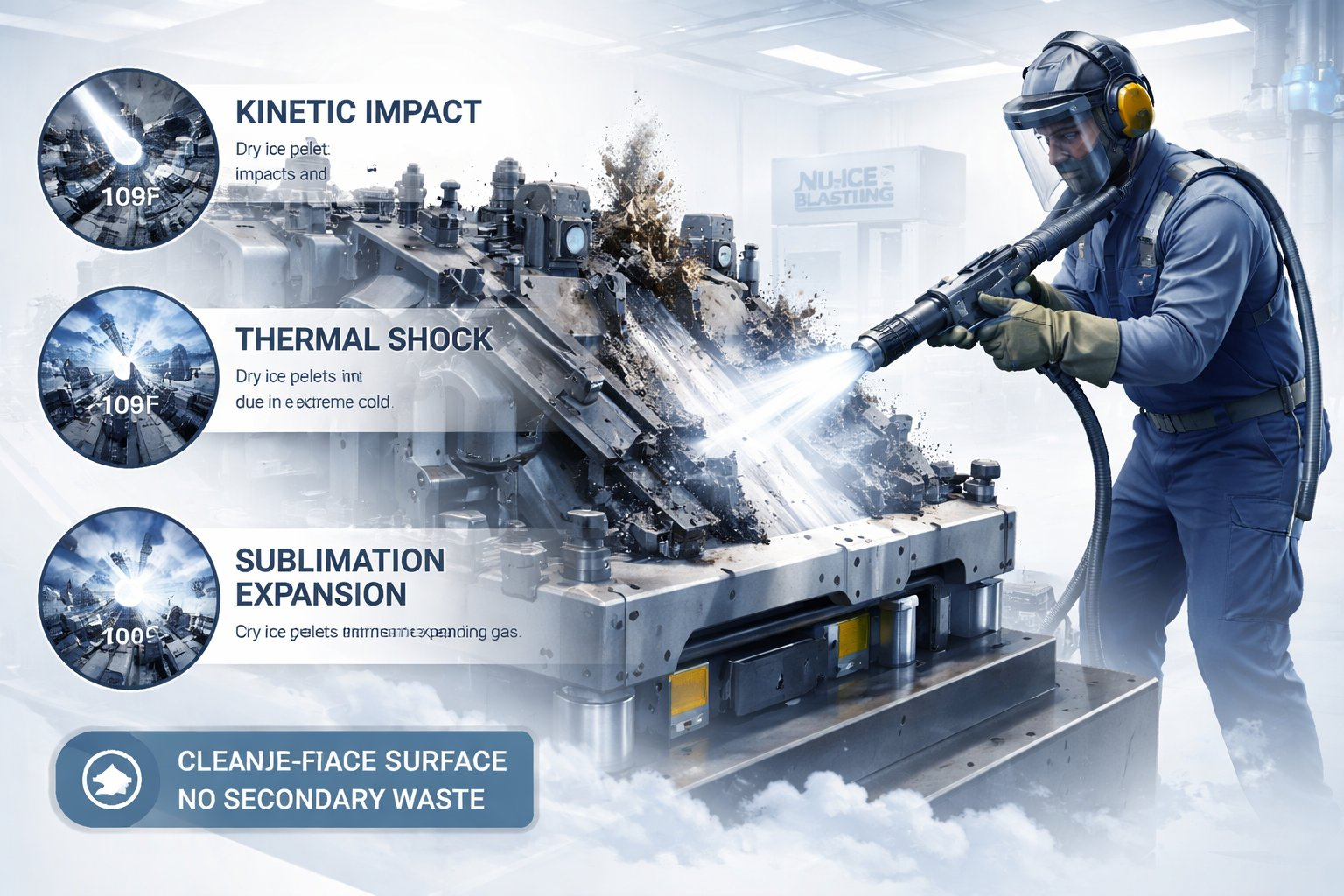
Kinetic Impact
As dry ice pellets are propelled by compressed air, their kinetic energy allows them to penetrate and loosen surface contaminants upon contact.
Thermal Shock
The extreme cold of the dry ice pellets (-109°F) creates a rapid temperature differential, causing the bond between the substrate and the contaminant to become brittle and crack.
Sublimation Expansion
As the pellets sublimate into gas, they expand rapidly in volume. This micro-explosion of gas occurs underneath the contaminant, effectively lifting it off the surface. Together, these forces ensure a thorough clean without damaging the underlying equipment.
A standard Nu-Ice Blasting™ system consists of several integrated components designed to deliver consistent cleaning power. The process begins with an air compressor, which provides the necessary pressure and volume of air to propel the media. Inside the machine, a dry ice hopper stores the CO2 pellets until they are needed. A precision metering system then feeds a controlled amount of pellets into the airflow. Finally, the hose and nozzle assembly allows the operator to direct the stream. The nozzle is specifically engineered to maximize the velocity of the pellets, ensuring they reach the surface with enough force to remove stubborn residues effectively.
Founded in 2008 and based in Jackson, Michigan, Nu-Ice Dry Ice Blasting™ is a dedicated American manufacturer of high-quality dry ice blasting equipment. The company prides itself on “Made in the USA” engineering, focusing on the production of durable and efficient machines designed for the most demanding industrial environments. As a manufacturer rather than a service provider, Nu-Ice Dry Ice Blasting™ provides the technology necessary for facilities to perform in-house maintenance. Their systems are widely used for dry ice blasting spatter and other stubborn industrial residues across various sectors. By maintaining a focus on simple, robust designs, the company ensures that its equipment remains reliable for long-term use, helping manufacturers reduce downtime and improve overall production quality through superior cleaning standards.
The engineering behind Nu-Ice Blasting™ equipment focuses on providing consistent performance through several integrated features. Each machine is equipped with a professional-grade blasting gun and a variety of interchangeable nozzle options, allowing operators to adjust the blast pattern based on the specific geometry of the target surface. To ensure the integrity of the cleaning media, the units typically include an integrated moisture separator. This component removes condensation from the compressed air supply, preventing the dry ice pellets from clumping or freezing together inside the system. Furthermore, an aftercooler is utilized to stabilize the temperature of the incoming air. These technical features work in tandem to maintain a steady flow of pellets from the hopper to the surface, ensuring the equipment functions reliably during extended industrial cleaning cycles without internal blockages or mechanical interference.
Nu-Ice Dry Ice Blasting™ manufactures a range of equipment with technical specifications designed to meet varying industrial requirements. For example, the IB Professional model features a compact footprint with dimensions of approximately 14″ in width, 22″ in depth, and 21″ in height, weighing roughly 75 lbs when empty. The hopper capacity for these units generally holds up to 20 lbs of dry ice pellets. Operationally, the equipment requires an air flow range between 50 and 150 CFM, depending on the specific nozzle and application. The operating pressure range typically spans from 50 to 125 PSI. Regarding media usage, dry ice consumption is adjustable via the metering system, generally ranging from 0.5 to 3 lbs per minute. These specifications ensure the equipment is portable while providing sufficient capacity for heavy-duty industrial tasks.
The operational sequence for using Nu-Ice Blasting™ equipment begins with the preparation and setup phase, which involves connecting the unit to a suitable compressed air source and ensuring all hoses are securely coupled. Safety requirements are a critical component of the workflow; operators must wear appropriate personal protective equipment (PPE), including thermal gloves, eye protection, and hearing protection, due to the extreme cold of the CO2 and the noise generated by high-velocity air. The typical workflow steps proceed with filling the hopper with fresh dry ice pellets and adjusting the feed rate on the control panel. Once the system is pressurized, the operator directs the blasting gun at the substrate, moving in a methodical pattern to ensure even coverage. After the task is complete, the system is depressurized, and any remaining pellets are cleared from the hopper.
Nu-Ice Blasting™ equipment is utilized across a broad spectrum of sectors due to its non-abrasive and residue-free nature. In manufacturing and production environments, the technology is frequently applied to welding equipment cleaning, as well as the maintenance of molds, dies, and automated assembly lines. Within the food processing and sanitation industry, the equipment is used to clean conveyors, ovens, and packaging machinery, adhering to strict hygiene standards without the use of water. Historical restoration projects rely on the process for cleaning delicate surfaces like stone or wood without causing structural damage. Additionally, the automotive and aerospace industries utilize dry ice blasting for engine components and landing gear maintenance. The electrical sector also employs this method for cleaning energized equipment, such as switchgear and transformers, because dry ice is non-conductive and does not introduce moisture into sensitive electronic systems.
The primary advantage of Nu-Ice Blasting™ is the complete elimination of secondary waste, as the CO2 pellets sublimate into a gas upon impact. This non-abrasive surface interaction ensures that the underlying substrate is cleaned without the profiling or etching common with grit blasting. Because it is a dry, chemical-free process, it is suitable for use on moisture-sensitive components and in environments where toxic solvents are prohibited. When considering welding equipment cleaning, these features allow for frequent maintenance without degrading the equipment. Operational and environmental considerations include the need for proper ventilation to manage CO2 levels and the use of insulated containers to maintain the integrity of the dry ice pellets during storage and handling.
Nu-Ice Dry Ice Blasting™ offers a variety of accessories to ensure seamless integration into existing industrial workflows. Standard systems include high-pressure hoses and a selection of specialized nozzles designed for different surface geometries and contaminant types. To maintain optimal performance, the use of aftercoolers is recommended to remove heat and moisture from the compressed air supply, preventing equipment freeze-ups. For long-term storage, dry ice must be kept in dedicated insulated chests to minimize sublimation losses. Regular maintenance of the equipment involves inspecting seals and hoses to ensure the system remains airtight and efficient during operation.
Frequently Asked Questions (FAQs)
What is dry ice blasting?
Dry ice blasting is an industrial cleaning method that uses solid CO2 pellets accelerated by compressed air. The pellets sublimate on impact, removing surface contaminants through a combination of kinetic energy, thermal shock, and rapid gas expansion without leaving residue.
Is the process compatible with sensitive equipment?
Yes, Nu-Ice Blasting™ is non-abrasive and non-conductive. It can be used on delicate surfaces, electrical components, and precision tooling without causing the surface wear or mechanical damage often associated with traditional sandblasting or wire brushing methods.
What are the primary safety considerations?
Operators must use personal protective equipment, including insulated gloves, eye protection, and hearing protection. Additionally, because the process involves the release of CO2 gas, equipment should be used in well-ventilated areas to ensure safe oxygen levels are maintained.
What infrastructure is required to run the equipment?
The system requires a reliable source of dry ice pellets and a high-volume compressed air supply. Depending on the specific Nu-Ice Blasting™ model, air requirements typically range between 50 and 150 CFM with pressures up to 125 PSI.
How does this compare to abrasive blasting?
Unlike sand or bead blasting, dry ice does not use hard media that can erode the substrate. It eliminates the need to collect and dispose of spent abrasive media, as the dry ice simply disappears into the atmosphere after cleaning.
What is the environmental impact of this process?
Dry ice blasting is an eco-friendly alternative to chemical cleaning. It uses recycled CO2 that is a byproduct of other industrial processes, does not contribute to the greenhouse effect, and eliminates the need for hazardous chemical solvents or detergents.
Can Nu-Ice Blasting™ remove heavy industrial buildup?
The equipment is specifically designed to remove stubborn materials such as bitumen, resins, adhesives, and slag. By adjusting the pellet feed rate and air pressure, the system can be tuned to handle varying levels of contaminant thickness and adhesion.
As manufacturing facilities continue to seek methods to optimize maintenance schedules and reduce equipment wear, the adoption of specialized cleaning technologies remains a focal point. Nu-Ice Dry Ice Blasting™ supports these efforts by engineering and manufacturing industrial dry ice blasting equipment in Jackson, Michigan. The company’s focused product line is designed to deliver consistent cleaning performance across diverse sectors, ranging from heavy fabrication to food processing, without the introduction of secondary waste streams or chemical residues. By providing access to non-abrasive, dry cleaning technology, Nu-Ice Blasting™ offers industrial operators a means to maintain asset integrity and operational efficiency. For organizations evaluating the integration of dry ice blasting into their maintenance protocols, detailed technical specifications, equipment configurations, and operational guidance are available directly from the manufacturer.