
Beyond the Feed: How Social Media Signals Are Feeding AI Recommendations for Pest Control
As search technology evolves, the way pest control companies are evaluated is fundamentally changing. The era of static “blue links” is giving way to dynamic, AI-driven search experiences, voice assistants, and zero-click answers. These new systems do not just list websites; they summarize information from multiple sources to recommend the “best” service provider.
In this ecosystem, social media is becoming a critical input shaping these summaries. AI systems look for consistency across platforms, clarity in service descriptions, and signals that indicate legitimacy and activity. For pest control companies, this means social presence now affects visibility even when users never click on a Facebook or Instagram profile. The machines are watching and judging your business based on what they see in the feed.
A recent analysis by Social Media Explorer examined how pest control companies are adapting to this environment by aligning their social media content with how AI systems interpret businesses. The report emphasized that incomplete or inconsistent information can reduce the likelihood of being recommended in AI-generated answers, which are increasingly the first point of contact for homeowners in distress.
The “Trust Signals” That AI Looks For
AI models like Google’s Gemini, ChatGPT, and Perplexity don’t “read” social media the way humans do. They analyze patterns and entities. They are looking for signals that resolve uncertainty about a business. Is this company still open? Do they actually serve the town they claim to? Are they an authority on termites or just general bugs?
According to Search Engine Land, modern SEO must focus on “entity-based optimization” rather than just keywords. This means that a pest control company’s social media activity helps define its “entity” in the Knowledge Graph. A steady stream of posts about “mosquito control in Baton Rouge” reinforces the connection between the business, the service, and the location. Without these signals, an AI system may be less confident in recommending the business for a specific local query.
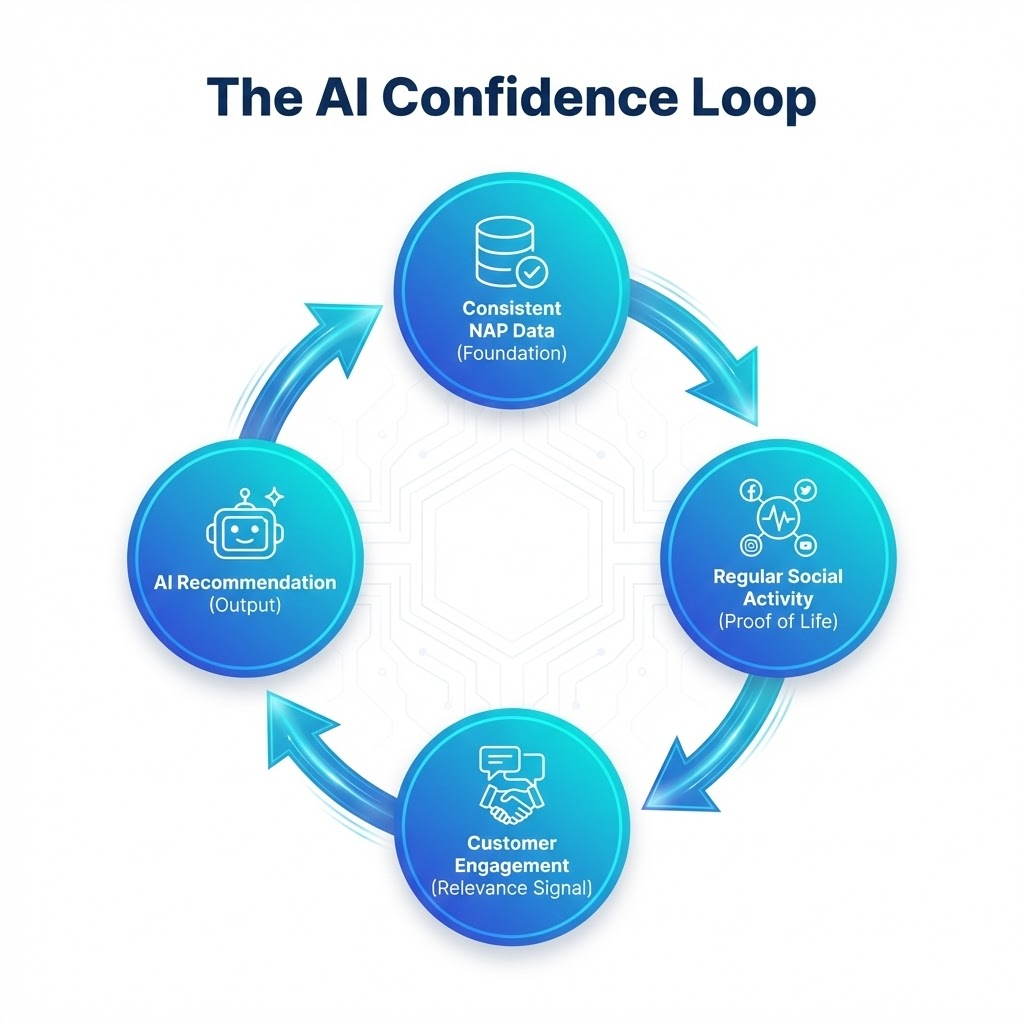
For example, a pest control company that regularly posts educational content (e.g., “Signs of Formosan Termites in Spring”), service updates, and community involvement presents stronger contextual signals than one with a dormant presence. These signals help AI systems verify that the business is active, relevant, and authoritative.
Consistency is Currency for Algorithms
This aligns with broader trends in “Answer Engine Optimization” (AEO) and local discovery. AI systems synthesize data from websites, reviews, business listings, and social platforms to determine which providers appear trustworthy.
Inconsistent data is a “trust killer” for both humans and machines. If your Facebook page says you open at 8:00 AM, but your Google Business Profile says 9:00 AM, an AI system treats this as ambiguity. High ambiguity leads to lower recommendation frequency. Sprout Social data highlights that brand consistency across platforms can increase revenue by up to 23%, a figure that reflects both human trust and algorithmic visibility.
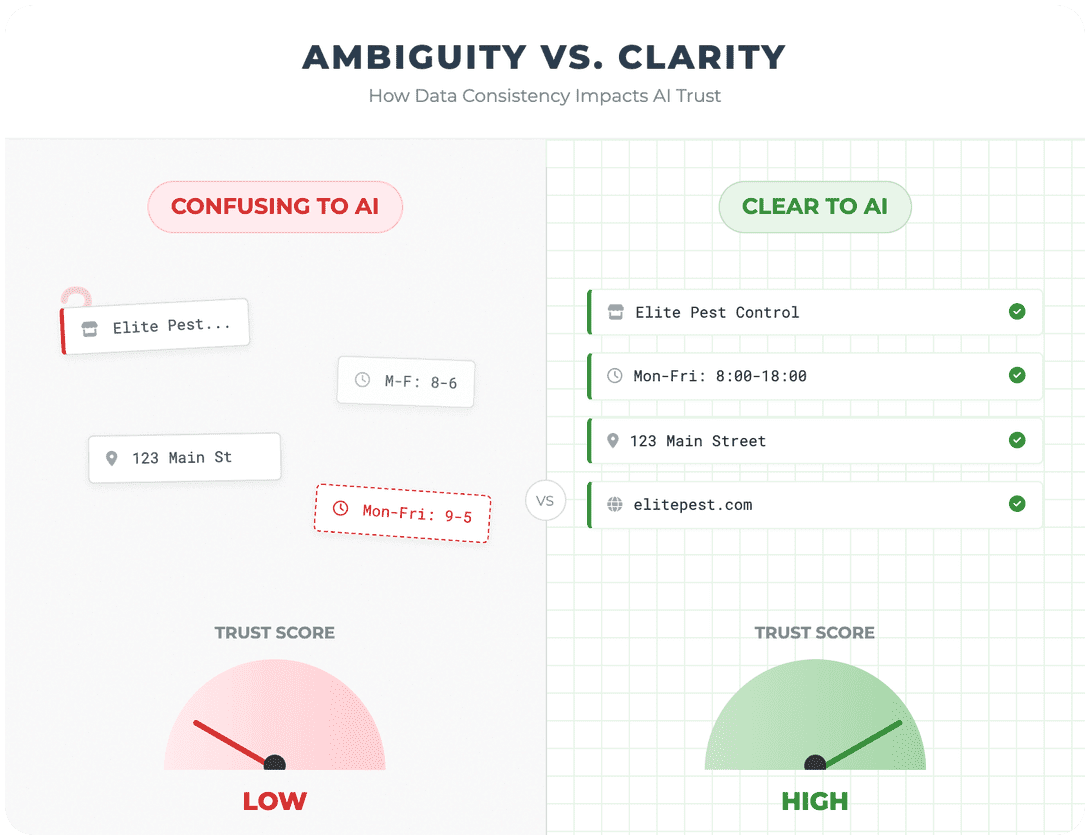
For pest control companies, this means that social media profiles must be treated as “canonical” data sources. The Name, Address, and Phone Number (NAP) must match what is on the website. Service descriptions should use the same terminology. This consistency trains the AI to understand exactly who you are and what you do, increasing the odds that you will be surfaced when a homeowner asks Siri, “Who is the best termite exterminator near me?”
Social Media as a “Living” Knowledge Graph
The larger implication is that social media is no longer just a human-facing channel. It also feeds machine understanding. When a pest control company posts a video of a technician removing a hornet’s nest, they are doing two things: building trust with human viewers and providing “visual entities” for image recognition algorithms.
Some agencies are now incorporating social media into broader AI readiness strategies. BlakSheep Creative has referenced this integration as part of its approach to helping pest control companies appear accurately in modern discovery environments. The emphasis is on reducing ambiguity so both humans and machines can easily understand the business.
By regularly publishing content that answers specific questions (e.g., “Is this spider poisonous?” or “How much does a termite inspection cost?”), Pest control companies create a library of answers that AI systems can reference. This effectively turns a social media feed into a database of expertise, positioning the brand as a verified authority in the local market.
The Future of Discovery
As AI-driven recommendations become more common, pest control companies may find that social media contributes indirectly to lead quality and volume. Businesses that are clearly and consistently represented are more likely to be recommended to homeowners with urgent needs.
For pest control providers navigating an increasingly automated discovery landscape, the goal is clear: align social content with clarity and credibility. It is not just about getting likes; it is about teaching the algorithms that you are the best answer to the customer’s problem.